
The widening West Asia conflict is opening another dangerous front, this time around the Red Sea, as Saudi Arabia warns Yemen’s Houthi movement that it will respond firmly to missile and drone attacks on the kingdom.
The warning came after a series of Houthi attacks reportedly wounded 13 civilians in southern Saudi Arabia and damaged homes and vehicles. Saudi authorities said attacks targeted areas including Khamis Mushait, Abha and Taif.
What makes the latest escalation particularly significant is its location.
The fighting is unfolding close to some of the world’s most important maritime routes. The Houthis have recently expanded their control along Yemen’s Red Sea coast and around the Bab el-Mandeb Strait, a narrow waterway connecting the Red Sea with the Gulf of Aden.
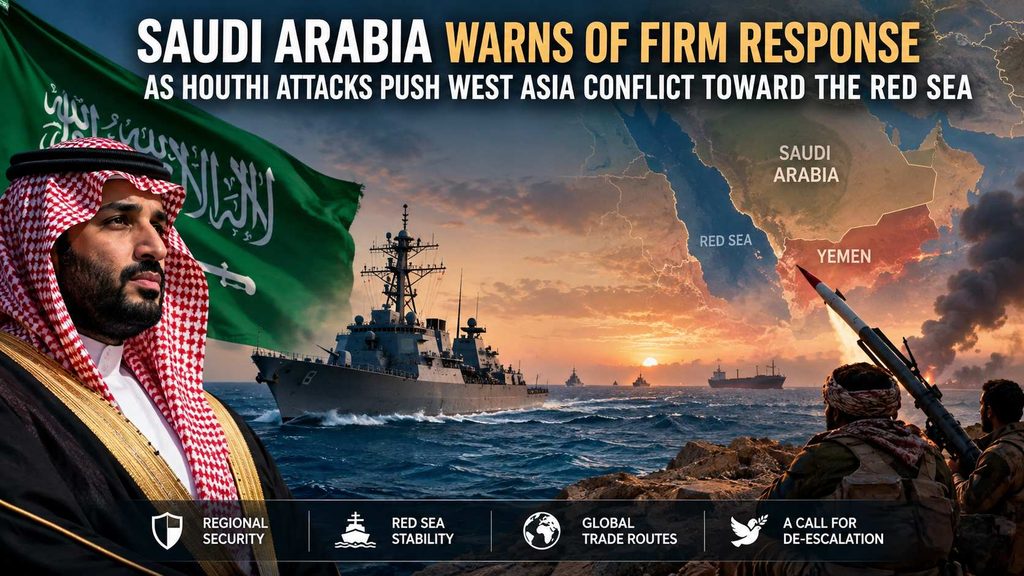
That means the consequences of the conflict could extend well beyond Saudi Arabia and Yemen.
Riyadh Sends a Clear Warning
Saudi Arabia’s response followed attacks involving ballistic missiles and drones.
The Saudi-led coalition said it would deal with the attacks “firmly” and take measures intended to protect the kingdom’s sovereignty. Saudi authorities also issued temporary air-raid alerts across several regions, including Mecca, Jeddah and Taif, before the warnings were lifted.
The warnings were significant because they showed that the latest fighting is creating security concerns well beyond the immediate battlefield.
For Saudi Arabia, the issue is not only the threat to cities and military facilities. Its energy infrastructure and export routes are also increasingly exposed.
Houthis Claim Large Missile and Drone Attack
The Houthis have claimed responsibility for attacks against Saudi targets, including what they described as a large-scale strike involving dozens of missiles and drones against King Khalid airbase in Khamis Mushait.
Saudi authorities confirmed that missile and drone attacks had occurred but did not endorse all of the Houthi claims about the scale or targets.
That distinction matters. Battlefield claims from both sides cannot always be independently verified, and the competing accounts provide an incomplete picture of the damage.
What is clear is that attacks have reached Saudi territory and that Riyadh is preparing for further confrontation.
More Than a Yemen Problem
For years, Yemen’s war has largely been viewed as a separate conflict involving the Houthi movement and forces supporting Yemen’s internationally recognized government.
The latest developments are making that separation increasingly difficult.
The Houthis have advanced along Yemen’s Red Sea coast and taken positions around the Bab el-Mandeb Strait. The group has also declared a maritime blockade and targeted Saudi-linked shipping.
This matters because Bab el-Mandeb is one of the world’s critical maritime chokepoints.
Ships using the route can carry energy supplies, manufactured goods and other cargo between the Indian Ocean and the Mediterranean through the Red Sea and Suez Canal.
Any prolonged disruption could therefore affect international shipping, insurance costs, delivery times and energy markets.
Why Bab el-Mandeb Matters So Much
The Red Sea has become even more strategically important because the wider conflict has already disrupted traffic through the Strait of Hormuz.
The two waterways serve different routes, but both are vital to international energy and commercial shipping.
If shipping companies face serious risks at both ends of the region’s major maritime network, vessels may have to take longer routes around Africa.
That can add days to journeys and increase fuel, insurance and freight costs.
Qatar has already warned that a closure of Bab el-Mandeb could have severe consequences for the global economy.
The concern is therefore bigger than the immediate Saudi-Houthi confrontation.
It is about whether another major global shipping route could become increasingly difficult to use.
Saudi Oil Infrastructure Is Also Under Pressure
Another major concern is Saudi Arabia’s energy infrastructure.
The Houthis have targeted Saudi oil-related facilities, while a separate attack has disrupted the kingdom’s East-West oil pipeline, according to recent reporting.
The pipeline is strategically important because it provides Saudi Arabia with a route to transport crude toward the Red Sea while avoiding the Strait of Hormuz.
With that route disrupted and tensions around the Red Sea increasing, Saudi Arabia faces pressure on multiple sides of its energy-export network.
That is one reason the latest developments are being watched closely by energy markets.
The Human Cost Is Growing
While international attention is focused on oil and shipping, the conflict is also producing a growing humanitarian crisis inside Yemen.
The United Nations has reported that renewed fighting since the beginning of September has displaced more than 100,000 people, while humanitarian operations are facing increasing difficulties because of insecurity and damaged infrastructure.
The renewed fighting follows the collapse of a period of relative calm that had reduced large-scale violence in Yemen.
For civilians living near the fighting, the return of airstrikes, missile attacks and ground clashes means renewed displacement and uncertainty.
Saudi Arabia Faces a Difficult Calculation
Riyadh now faces a difficult strategic situation.
Responding forcefully could demonstrate that attacks on Saudi territory will not go unanswered. At the same time, further escalation could deepen the conflict and expose more Saudi cities, military installations and energy infrastructure to attacks.
The Saudi warning therefore comes at a particularly sensitive moment.
The kingdom has also been engaging with other regional governments as it looks for political and security support. Saudi Crown Prince Mohammed bin Salman has held talks with regional leaders amid the escalation.
The United States Is Watching From the Sidelines
Another important question is how far Washington will become involved.
The United States remains deeply engaged in the wider West Asia conflict, but recent reporting indicates reluctance to enter another direct military confrontation with the Houthis.
That leaves Saudi Arabia facing a potentially expanding security challenge while seeking regional and international support.
The situation could change quickly if attacks intensify or if international shipping suffers significant disruption.
Iran’s Role Remains a Major Point of Tension
The Houthis are aligned with Iran, which has long supported the group, although Tehran denies directing Houthi decisions.
Saudi Arabia and other regional governments view Iranian support as an important part of the wider security challenge.
Iran, meanwhile, says the Houthis operate independently.
Those competing positions are likely to remain central to diplomatic discussions as the conflict develops.
A New Pressure Point for the Global Economy
The latest Saudi-Houthi escalation demonstrates how interconnected the conflicts across West Asia have become.
A confrontation in Yemen can affect Saudi security. Saudi security concerns can affect oil infrastructure. Threats around the Red Sea can affect international shipping. And disruption to shipping and energy supplies can eventually reach economies far beyond the Middle East.
That is why the Bab el-Mandeb Strait is receiving increasing international attention.
The question is no longer simply whether Saudi Arabia and the Houthis will exchange more attacks.
The bigger question is whether the fighting will turn the Red Sea into another sustained disruption point for global trade and energy.
For now, Saudi Arabia has issued its warning, the Houthis have indicated that they intend to continue their campaign, and fighting is intensifying around one of the world’s most strategically important maritime corridors.
What happens next could determine whether the latest escalation remains primarily a regional confrontation—or becomes another major shock to global shipping and energy markets.