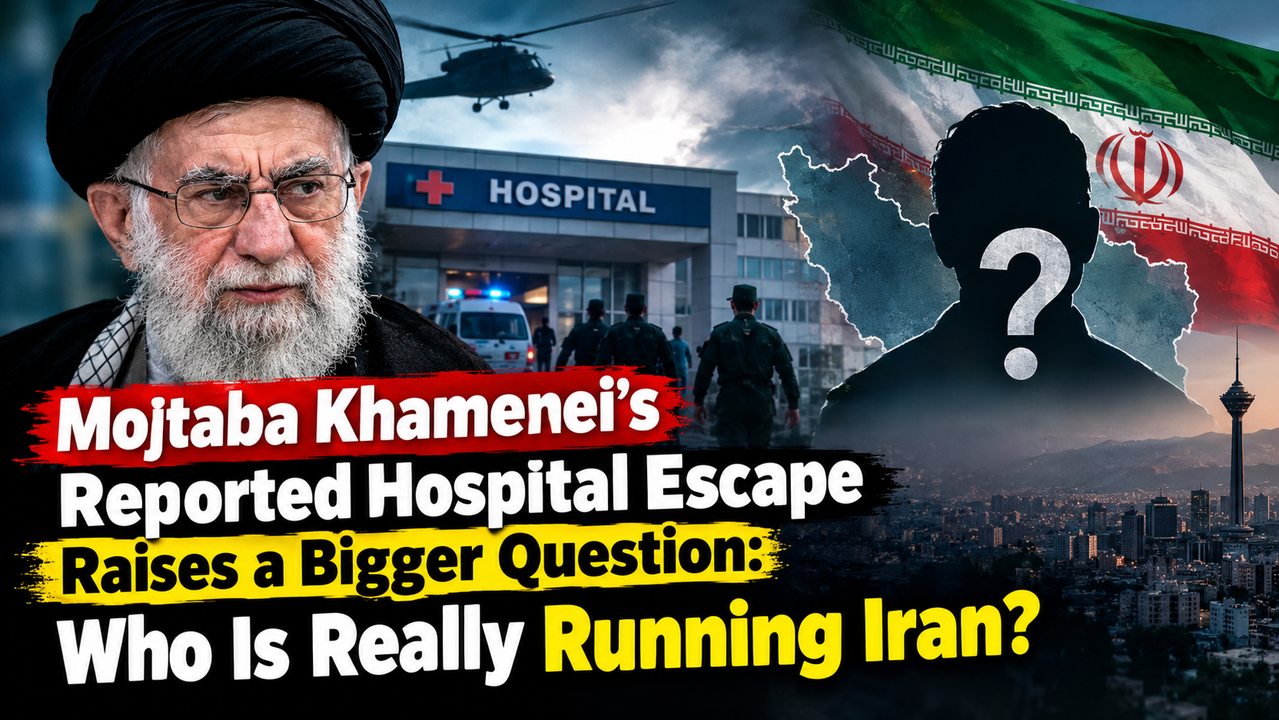
Iran’s Supreme Leader Mojtaba Khamenei has spent much of the war out of public view. Now, a new report claims he narrowly survived another U.S.-Israeli strike after being pulled from the rubble of a hospital in Tehran.
If confirmed, the incident would be extraordinary.
But there is an important reason to be cautious: the account has not been independently verified, and Tehran has not publicly released evidence confirming the reported hospital incident. What is known is that Mojtaba was seriously wounded during the opening strikes of the war and has remained almost completely absent from public view since becoming Iran’s Supreme Leader.
That makes the latest report significant for another reason.
The question is no longer only whether Mojtaba Khamenei survived another attack. It is whether Iran can continue to operate with its Supreme Leader largely invisible while the country remains at war.
What the New Report Claims
According to the report cited by Hindustan Times, Mojtaba Khamenei was receiving treatment at a Tehran hospital when joint U.S. and Israeli strikes hit the facility.
The report says parts of the hospital collapsed and that Mojtaba had to be pulled from the rubble.
The alleged incident would represent a second serious brush with death for the Iranian leader. He was already badly injured during the first strikes of the war on February 28, when Israel and the United States launched attacks that killed his father, Ayatollah Ali Khamenei.
However, there is currently no independently verified evidence establishing that Mojtaba was inside the hospital when it was struck or confirming the details of his reported rescue.
That distinction is essential.
In a war where information is itself part of the battlefield, an unverified report about the health or location of a national leader can spread much faster than evidence confirming it.
Mojtaba’s Absence Has Become a Story of Its Own
Mojtaba Khamenei’s unusual disappearance from public life began after he succeeded his father.
Reuters reported in August that, despite holding Iran’s highest political and religious position, Mojtaba had not appeared publicly in a verified photograph, video or audio recording since his appointment. Iranian officials have said he remains in control and is deliberately staying hidden because of assassination threats.
That explanation has not stopped speculation.
For a country whose Supreme Leader traditionally represents the ultimate source of political authority, his prolonged absence creates an unusual information vacuum.
Iranian officials say Mojtaba continues to receive reports, meet senior officials and make major decisions from a secure location.
But outsiders cannot independently observe most of that process.
It is a little like watching a government operate from behind a closed door: decisions are still emerging, but the person supposedly making the final call is rarely seen.
U.S. Officials Also Say He Survived
The United States has not publicly treated Mojtaba as dead.
President Donald Trump said in August that he believed the Iranian leader was alive but had been “very seriously wounded.” Reuters reported that Trump based part of his assessment on the fact that Iranian negotiators continued to indicate that they needed to consult Mojtaba before making important decisions.
That is significant because it suggests Washington also believes Mojtaba remains part of Iran’s decision-making structure.
But it does not answer the most difficult questions about his health.
How badly is he injured?
Can he communicate normally?
How frequently can he meet officials?
And how much of the government’s daily decision-making has been delegated to other senior figures?
Those questions remain difficult to answer from outside Iran.
Iran’s Government Says He Is Still in Charge
Iranian officials have repeatedly maintained that Mojtaba remains the ultimate authority.
Reuters reported that senior Iranian sources said he continues to meet a small group of top officials, remains involved in deliberations and has the final say on major decisions.
His limited public visibility, officials argue, is a security measure.
That explanation has some logic in the context of a war in which senior Iranian officials and military commanders have been targeted.
But it also creates a political problem.
The more invisible the leader becomes, the harder it is for the public and foreign governments to independently judge his condition and role.
The Real Power Question Is Bigger Than Mojtaba
Even if the latest hospital report turns out to be accurate, Iran’s political system is not dependent on one person appearing on television every day.
The Revolutionary Guard remains a major pillar of the country’s security and political structure.
Reuters has reported that the Guards have gained greater influence during the war and that Iran’s top decision-making circle includes senior military commanders as well as political figures such as President Masoud Pezeshkian and parliament speaker Mohammad Bagher Ghalibaf.
That means Iran’s leadership structure may be more resilient than the mystery surrounding Mojtaba’s health suggests.
But there is an important difference between institutional continuity and unquestioned leadership.
Major decisions about war, negotiations and a possible settlement with Washington require clear authority at the top.
Why His Health Matters for U.S.-Iran Talks
This is where the story becomes much larger than a hospital strike.
The United States and Iran have continued exploring diplomacy despite the war.
Reuters reported earlier in September that Iranian officials said Mojtaba remained central to major decisions, including potential negotiations with Washington.
If Iranian negotiators need approval from the Supreme Leader before accepting an agreement, then his physical ability to communicate and make decisions becomes directly relevant to diplomacy.
A prolonged absence could therefore create uncertainty at exactly the moment when Iran needs to make difficult choices.
A ceasefire, nuclear agreement or reopening of the Strait of Hormuz would involve decisions with enormous consequences.
Who signs off?
Who can speak for Iran?
And can foreign governments be certain that an agreement reached through intermediaries has the approval of the country’s ultimate authority?
Those questions become harder when the Supreme Leader remains hidden.
The Information Vacuum Has Strategic Value
There is another side to Mojtaba’s disappearance.
Keeping his location secret may protect him from further attacks.
In a conflict where the United States and Israel have demonstrated the ability to strike senior Iranian targets, revealing his movements could create a direct security risk.
Iran therefore has an obvious reason to restrict information.
But secrecy also creates uncertainty for Iran’s adversaries.
If Washington does not know exactly where Mojtaba is or how involved he remains in decision-making, it has less certainty about Iran’s internal chain of command.
In that sense, his invisibility can function as both a shield and a source of strategic ambiguity.
Why the “Pulled From Rubble” Claim Needs Caution
The dramatic language surrounding the latest report makes verification especially important.
Claims involving the death, survival or physical condition of senior political leaders often spread rapidly during wartime.
The current evidence supports several facts: Mojtaba was seriously wounded during the initial strikes; Iranian officials say he survived; Trump has also said he believes Mojtaba is alive; and Reuters has reported that senior Iranian sources consider him involved in major decisions.
The new claim that he was pulled from a hospital after another strike belongs in a different category.
It is a reported account that has not yet been independently confirmed.
That does not make it impossible.
It means readers should distinguish between what has been established and what is still being reported.
Iran’s Leadership Faces a Different Kind of Pressure
Mojtaba’s personal condition is unfolding against a much larger crisis.
Iran has spent months under military pressure while its economy faces the effects of war and restrictions on oil exports. Reuters has reported that the country’s political system has remained intact despite major military losses, with the Revolutionary Guard playing a central role in the wartime structure.
That resilience matters.
The disappearance of one leader does not automatically mean the collapse of a state.
But prolonged uncertainty at the top can make an already complicated situation harder to manage.
Iran needs to make decisions about war, diplomacy, the economy and its relationship with the United States.
Those decisions require a functioning chain of command.
The Bigger Story Is the Mystery Around Iran’s Most Powerful Office
The latest report may eventually be confirmed, corrected or shown to have been incomplete.
But regardless of what happened inside that Tehran hospital, the underlying story remains.
Mojtaba Khamenei is one of the world’s most powerful leaders and, at the same time, one of its least visible.
There has been no independently verified public photograph, video or audio appearance since he assumed the Supreme Leadership. Iranian officials insist that he remains alive, active and ultimately in control, while foreign observers continue to rely heavily on indirect information.
That creates an extraordinary situation.
Iran is fighting a major war, negotiating through intermediaries and making decisions that could affect global energy markets, yet the man at the top remains largely unseen.
The reported hospital incident therefore matters not simply because Mojtaba may have survived another strike.
It matters because every new report about his whereabouts, health or ability to govern highlights the same unresolved question:
How does Iran make its biggest decisions when the person with the final say remains almost completely out of sight?
Until Tehran provides independently verifiable evidence about Mojtaba’s condition and public role, that question will remain one of the most closely watched mysteries of the Iran war.