The BRICS Summit in New Delhi was not only about speeches, declarations and discussions among the expanded group of emerging economies. Away from the main summit table, a busy series of bilateral meetings gave India another opportunity to strengthen relationships across Asia, Africa and beyond.
Prime Minister Narendra Modi used the sidelines of the 2026 BRICS Summit for discussions with several foreign leaders, with defence, security, critical technologies, trade and investment emerging as recurring themes.
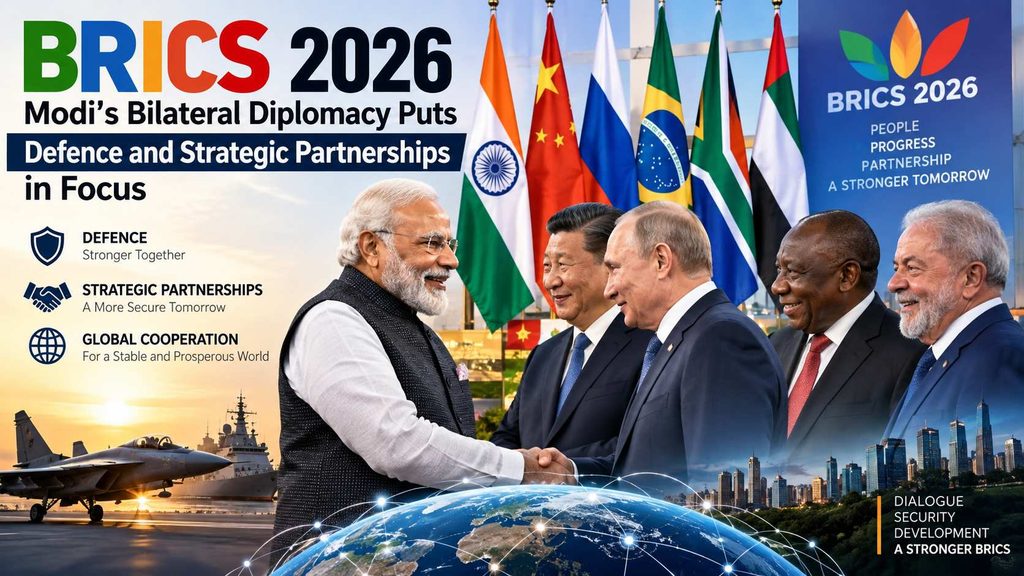
The meetings added another layer to India’s BRICS diplomacy: while the summit focused on issues affecting the wider grouping, the bilateral conversations concentrated on specific partnerships and areas where India and individual countries could expand cooperation.
BRICS Became More Than a Summit Table
The 18th BRICS Summit brought together an expanded group of countries in New Delhi under India’s 2026 chairship.
The leaders adopted the New Delhi Declaration, which reaffirmed cooperation across political and security affairs, economics and finance, technology, sustainable development and people-to-people ties. The declaration also called for dialogue and diplomacy to address international conflicts and supported stronger cooperation among developing countries.
But for India, the diplomatic activity did not stop when the formal BRICS discussions ended.
The sidelines became a platform for separate conversations with countries that have different strategic and economic relationships with New Delhi.
Defence Moves Higher on India’s Diplomatic Agenda
Among the clearest themes was defence cooperation.
During Modi’s meeting with Malaysian Prime Minister Anwar Ibrahim, the two sides discussed strengthening cooperation in defence as well as areas including semiconductors, critical minerals, clean energy and talent mobility.
The discussions with Ethiopian Prime Minister Abiy Ahmed also included defence cooperation and Indian investment, particularly in sectors connected with Ethiopia’s mineral resources.
These conversations show how India’s external partnerships are increasingly connecting traditional security cooperation with economic and technological interests.
Malaysia Brings Together Defence and Technology
The India-Malaysia discussions illustrated that modern strategic partnerships are no longer limited to military cooperation.
Defence was discussed alongside semiconductor manufacturing, critical minerals, clean energy and movement of skilled professionals.
That combination is significant because countries are increasingly treating technology supply chains and access to strategic resources as part of national security.
For India, building relationships in these areas can also support its broader effort to diversify supply chains and expand cooperation with countries across the Indo-Pacific.
Ethiopia Opens Another African Partnership
Africa was another important part of India’s BRICS diplomacy.
Modi’s meeting with Ethiopia’s Prime Minister focused on strengthening bilateral relations, including defence cooperation, investment and critical minerals.
India has increasingly sought deeper engagement with African economies through trade, development partnerships, technology and capacity building.
The Ethiopia discussions therefore extended beyond the immediate BRICS agenda and into India’s broader engagement with Africa.
Vietnam Adds an Indo-Pacific Dimension
Vietnam also featured prominently in India’s bilateral discussions.
Talks with Vietnamese Prime Minister Le Minh Hung included defence and security cooperation, rare earths, energy and space collaboration. The two sides also discussed a proposed two-plus-two ministerial mechanism and a long-term trade target.
The combination of defence, critical minerals and advanced technology gives the relationship a wider strategic dimension.
It also fits into India’s broader efforts to strengthen engagement with Southeast Asia under its Act East policy.
The China Conversation Remained Important
Among the most closely watched interactions at the summit was Modi’s meeting with Chinese President Xi Jinping.
India and China have faced significant differences in recent years, particularly concerning their border and broader strategic relationship. Their BRICS interaction therefore carried significance beyond the summit itself.
According to the Indian government, Modi emphasized that the two countries should remain sensitive to each other’s core concerns and continue working toward stable bilateral relations.
The discussion demonstrated how BRICS can provide a setting in which countries with unresolved bilateral issues continue diplomatic engagement while participating in a larger multilateral forum.
Russia and Iran Also Featured in the Diplomatic Schedule
Modi’s BRICS engagements extended to major geopolitical partners and countries at the centre of current regional tensions.
He held discussions with Russian President Vladimir Putin and Iranian President Masoud Pezeshkian during the summit period. The wider BRICS meeting itself took place against a backdrop of escalating conflict in the Middle East, making the diplomatic interactions particularly significant.
The New Delhi Declaration called for restraint, dialogue and diplomatic approaches to international disputes, reflecting the effort to maintain a common statement among countries with differing positions on major geopolitical issues.
Why the Sideline Meetings Matter
A summit declaration can establish broad principles, but bilateral meetings can produce more specific discussions.
Defence agreements, technology partnerships, investment projects and trade arrangements generally require country-to-country negotiations.
That is why the diplomatic activity surrounding a summit can sometimes be as important as the formal agenda.
In New Delhi, India’s conversations ranged from Southeast Asia to Africa, from critical minerals to defence, and from technology to investment.
The result was a much broader diplomatic programme than the BRICS agenda alone would suggest.
Critical Minerals Are Becoming a Strategic Issue
One particularly important theme running through several meetings was critical minerals.
These resources are essential for industries ranging from electronics and renewable energy to advanced manufacturing and defence technologies.
India’s discussions with Malaysia and Vietnam included critical minerals and related areas of economic and technological cooperation, while the Ethiopia engagement also included interest in the country’s mining sector.
This reflects a wider change in international diplomacy.
Countries are increasingly looking beyond traditional trade relationships toward securing access to the raw materials and technologies needed for future industries.
BRICS Also Focused on the Global Economy
The bilateral meetings took place alongside a broader BRICS discussion about changing global economic structures.
The New Delhi Declaration called for stronger economic and financial cooperation among members and reaffirmed efforts to expand trade, financial cooperation and the use of local currencies. It also emphasized science, technology and innovation as drivers of economic development.
These issues have become increasingly important as BRICS expands and seeks a greater role for emerging and developing economies in global decision-making.
A Summit Held Against a Difficult Geopolitical Backdrop
The 2026 BRICS Summit took place while conflicts and geopolitical tensions were creating uncertainty for energy markets, supply chains and international trade.
BRICS leaders expressed concern about global polarization and emphasized diplomatic approaches to conflict prevention and resolution. They also highlighted the need to maintain the flow of global trade, supply chains and energy.
For India, this created a complicated diplomatic environment.
New Delhi had to engage with countries that sometimes have sharply different positions on major international issues while simultaneously pursuing its own economic and security interests.
From Global Forum to Practical Partnerships
The most interesting feature of India’s BRICS diplomacy may therefore be the combination of two tracks.
At the multilateral level, India worked with BRICS members on broad questions involving global governance, economic cooperation, technology, security and development.
At the bilateral level, Modi’s meetings focused on practical relationships with individual countries.
Defence with some partners, critical minerals with others, investment and trade with others, and technology and energy cooperation across several relationships created a much more detailed diplomatic agenda behind the summit’s headline events.
What Comes Next?
The real test will be whether the discussions translate into concrete agreements and projects.
A meeting between leaders can open the door, but implementation usually depends on ministries, businesses, defence establishments and technical agencies continuing the negotiations after the cameras leave.
That is particularly true for areas such as defence production, semiconductor cooperation, critical minerals and advanced technology.
The New Delhi Summit has therefore created a broad framework, but the practical results will emerge over time.
The Bigger Picture
The 2026 BRICS Summit demonstrated that India’s role in the grouping is not confined to the formal meetings of BRICS leaders.
The summit also provided an opportunity for New Delhi to deepen individual partnerships across different regions.
From defence cooperation with Malaysia and Ethiopia to strategic discussions with Vietnam, China, Russia and Iran, Modi’s diplomatic schedule reflected the breadth of India’s external relationships.
The central story, therefore, is not simply what happened inside the BRICS summit hall.
It is what happened around it.
While BRICS leaders negotiated a common declaration on global challenges, India’s bilateral diplomacy was simultaneously working on a different set of priorities—security, defence, technology, resources, trade and investment.
That combination could prove to be one of the most important aspects of India’s 2026 BRICS presidency.