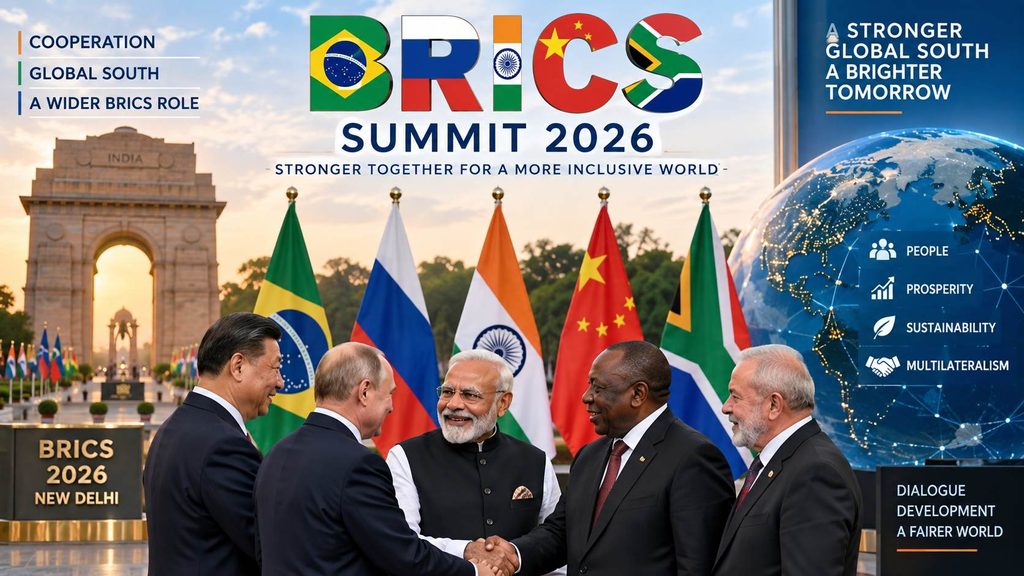
Prime Minister Narendra Modi has thanked the leaders of BRICS member countries for making the 2026 summit in New Delhi a “productive” gathering, bringing India’s year-long presidency of the grouping to a close.
But the bigger story from the Delhi summit goes beyond the closing remarks.
BRICS met at a time of intense geopolitical tension, disrupted trade routes, economic uncertainty and disagreements among its own members. Against that backdrop, the New Delhi summit became an exercise in finding areas where countries with very different interests could still work together.
The result was the New Delhi Declaration, a wide-ranging document covering global governance, trade, finance, technology, energy, food security, security concerns and cooperation among developing countries.
India’s BRICS Presidency Ends With a Call for Action
Modi’s message at the conclusion of the summit emphasized cooperation and practical implementation rather than simply producing another diplomatic declaration.
That distinction matters because BRICS has expanded significantly in recent years. Its membership now includes countries with different economic models, foreign-policy priorities and relationships with major global powers.
India therefore faced a complicated task during its 2026 presidency: keep the enlarged group focused on common interests without pretending that all members see global issues in the same way.
The official declaration itself recognizes the importance of consensus, sovereign equality and cooperation while placing BRICS activities under three broad pillars: political and security cooperation, economic and financial cooperation, and cultural and people-to-people ties.
The Delhi Declaration Became the Summit’s Main Takeaway
The adoption of the New Delhi Declaration was one of the central outcomes of the summit.
The document calls for stronger multilateralism and reform of international institutions, including the United Nations Security Council. BRICS members also reiterated their support for giving developing countries a greater voice in global decision-making.
The declaration also addresses trade barriers, unilateral sanctions and the functioning of the global trading system.
Rather than limiting the summit to political statements, BRICS leaders included cooperation on areas such as technology, food security, energy, sustainable development and financial systems.
That broad agenda reflects how the group is trying to evolve from a relatively small economic grouping into a wider platform for emerging and developing economies.
A Larger BRICS Means a More Complicated BRICS
The expansion of BRICS has increased its economic and geopolitical reach, but it has also made consensus more complicated.
The 2026 summit included countries with competing interests and different relationships with the world’s major powers. Reuters reported that the ongoing conflict involving Iran created an additional test for the group’s ability to agree on sensitive international issues.
Yet the members managed to issue a joint declaration calling for restraint and emphasizing dialogue and diplomacy in response to tensions in the Middle East.
That does not mean BRICS has suddenly developed a single foreign-policy position. Instead, the summit demonstrated that the members can sometimes agree on broad principles even when their individual strategic interests differ.
Modi Put the Global South at the Center
Another important theme of India’s presidency was the effort to give greater attention to the concerns of developing countries.
The New Delhi Declaration calls for a more representative international system and stronger participation by emerging and developing economies in institutions such as the UN and international financial organizations.
For India, this has been a recurring element of its diplomatic messaging: countries outside the traditional centers of global power should have a greater role in shaping decisions on trade, finance, technology, development and international security.
The summit provided a platform for that argument at a time when many developing economies are dealing with higher energy costs, supply-chain disruptions, debt pressures and geopolitical uncertainty.
Economics Remained at the Heart of BRICS
Despite the attention given to international conflicts, economics remained one of the group’s central concerns.
BRICS members discussed stronger economic cooperation, increased use of local currencies in trade and improved cross-border payment mechanisms. The declaration also supports efforts to strengthen the multilateral trading system and the role of the BRICS-led New Development Bank.
These proposals are part of a longer-running BRICS effort to make trade and financial cooperation less dependent on existing global structures.
However, the summit did not create a common BRICS currency. The focus instead remained on practical financial cooperation, payment systems and greater use of national currencies.
That distinction is important because financial integration among countries with very different monetary and regulatory systems is considerably more complicated than announcing a new currency.
Technology and AI Move Higher on the Agenda
Technology also received increasing attention during the summit.
Artificial intelligence, digital cooperation, innovation and technology infrastructure have become important areas for BRICS members as they look for ways to improve economic growth and technological capacity.
Chinese President Xi Jinping, for example, proposed deeper cooperation in areas including artificial intelligence, finance and trade within the expanded BRICS framework. Reuters reported that his proposals included an AI-related open-source initiative and other economic cooperation mechanisms.
This suggests that the future BRICS agenda may increasingly involve technology standards, digital payments, artificial intelligence and access to critical technologies alongside traditional economic issues.
Modi’s Bilateral Meetings Added Another Layer
The summit itself was only part of India’s diplomatic activity.
Alongside the formal BRICS meetings, Modi held discussions with several visiting leaders, including Russian President Vladimir Putin and Chinese President Xi Jinping.
The Modi-Putin discussions came against the backdrop of India’s long-standing defence and economic relationship with Russia. Reuters reported that the two leaders discussed strengthening bilateral ties ahead of the summit.
The interaction with Xi was particularly significant because India-China relations remain an important factor in Asian geopolitics.
These bilateral meetings showed why major multilateral summits are often as much about conversations between individual countries as they are about the official declaration.
Why the Summit Matters Beyond Delhi
The real test of the 2026 BRICS summit will not necessarily be the number of paragraphs in its declaration.
It will be whether the commitments made in New Delhi translate into practical cooperation.
That could mean stronger trade links, more efficient payment systems, cooperation in technology and artificial intelligence, joint work on food and energy security, and a greater role for developing countries in international institutions.
The Indian government has emphasized the need to turn BRICS from a discussion platform into an ecosystem capable of producing practical solutions. AP reported that Modi urged members to convert summit commitments into concrete action while addressing concerns ranging from geopolitical tensions to supply chains and critical minerals.
China Takes Over the BRICS Presidency
With India’s 2026 presidency now concluded, China will take over the chairmanship and host the next BRICS summit in 2027.
That transition will be closely watched because the grouping is entering a different phase. It is larger than the original BRICS format, its economic ambitions are expanding, and its members are operating amid increasingly complicated geopolitical rivalries.
India’s summit showed that consensus remains possible, but it also highlighted the challenge of maintaining that consensus as the group grows.
The Bigger Message From New Delhi
Modi’s description of the summit as productive captures one part of the story, but the more significant development may be that BRICS is becoming a broader platform for countries seeking greater influence in global economic and political affairs.
The Delhi summit did not eliminate disagreements between its members. Nor did it create a single BRICS position on every major international crisis.
Instead, it produced a framework for cooperation across trade, finance, technology, development, energy, food security and global governance.
That may ultimately prove more important than any single headline from the summit.
As India passes the BRICS chairmanship to China, the next question is straightforward: can the commitments made in New Delhi be converted into projects and policies that deliver measurable results?
The answer will determine how much influence the expanded BRICS can exercise in the years ahead.