
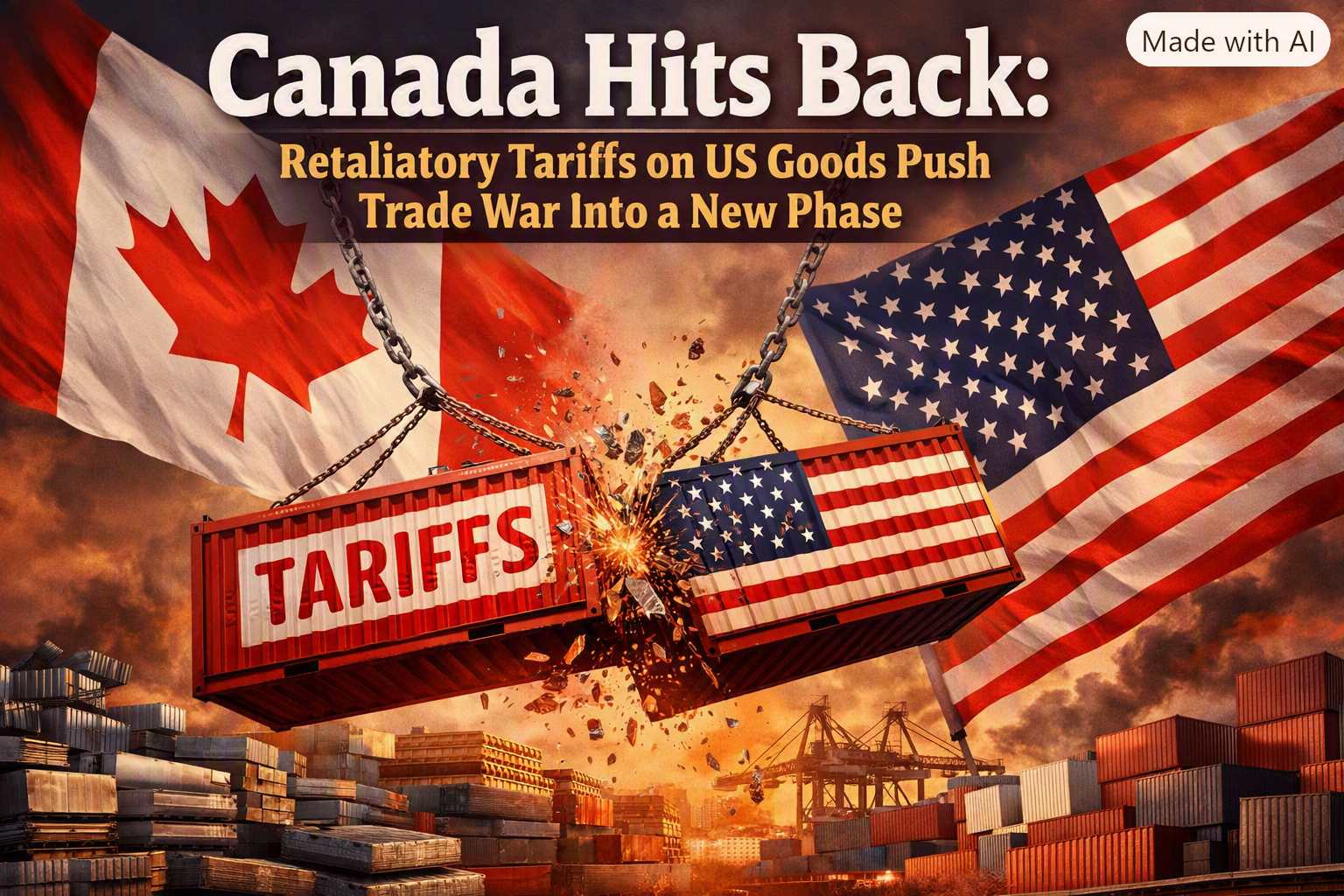
Canada has moved from warning to action.
After weeks of escalating tension with Washington, Ottawa has announced retaliatory tariffs on billions of dollars’ worth of American goods, marking a new chapter in the increasingly bitter trade dispute between two of the world’s closest economic partners.
But Canada’s response is about more than tariffs.
It is also a message to President Donald Trump: if the United States uses trade pressure to force concessions, Canada is prepared to make American exporters—and potentially American politicians—feel the consequences too.
Ottawa’s Answer: Dollar for Dollar
Canada announced retaliatory tariffs on C$27.6 billion, or roughly $20 billion, worth of US imports.
The new duties, which take effect on September 8, will cover more than 700 American products.
Tariff rates will range from 15% to 50%, depending on the product.
The targeted goods include steel, aluminum, furniture, clothing, cheese, appliances, seafood, electronics and tools.
The Canadian government has described the approach as a “dollar-for-dollar, rate-for-rate” response to Washington’s latest tariffs.
The message is straightforward: Canada does not believe retaliation is the preferred option, but it is no longer willing to accept economic punishment without responding.
From Trade Disagreement to Trade War
The latest escalation followed the collapse of negotiations between Ottawa and Washington.
The United States imposed new 50% tariffs on roughly $20 billion worth of Canadian imports, pushing Prime Minister Mark Carney’s government to respond with its own package.
But the stakes go far beyond the products currently listed.
The United States and Canada are deeply connected through cross-border supply chains.
Cars, machinery, food, metals and energy often move back and forth between the two countries before reaching their final customers.
That means tariffs aimed at one side of the border can quickly raise costs on the other.
An American manufacturer using Canadian materials may face higher costs.
A Canadian business relying on American machinery may face the same problem.
Consumers in both countries may eventually pay more.
This is the central danger of the escalating dispute.
The more integrated the economies are, the harder it becomes to hurt your trading partner without also hurting yourself.
The Auto Industry Could Become the Next Battlefield
The dispute is particularly dangerous because of the threat facing the North American auto industry.
Trump has threatened to raise tariffs on Canadian cars, trucks and auto parts to 50% from January 1, 2027.
That could have enormous consequences for the automotive supply chain.
The industry was built around decades of cross-border integration. A vehicle assembled in Canada or the United States may contain components that have crossed the border multiple times during production.
A major tariff increase could therefore disrupt factories, raise prices and put jobs at risk on both sides.
For Canada, particularly Ontario, the auto sector has become one of the most sensitive parts of the dispute.
And for Washington, the industry presents a difficult political problem: protecting American production is the stated goal, but disrupting the supply chain could also hurt American automakers and consumers.
Canada Is Trying to Fight Without Damaging Itself
Ottawa’s strategy is not to impose tariffs on everything.
Instead, it is trying to target products where retaliation can put pressure on American exporters while reducing the immediate impact on Canada’s own economy.
The government is also providing C$7.5 billion in new and enhanced support for workers and businesses affected by the trade dispute.
This reveals an important reality behind Canada’s retaliation.
Ottawa understands that tariffs are not free.
They can increase prices for consumers and create problems for Canadian companies that depend on US imports.
The challenge is therefore to make retaliation painful enough to create pressure in the United States—without causing more damage at home than the tariffs are intended to prevent.
That is a difficult balancing act.
The Political Battle Behind the Tariffs
The trade war is also becoming a political contest.
Some of the products on Canada’s tariff list come from regions and industries with political importance in the United States.
That suggests Ottawa is thinking beyond economics.
The goal is not simply to reduce imports.
It is to create pressure on American producers, workers and communities that may then pressure Washington to change course.
This strategy has a long history in international trade disputes.
When governments retaliate, they often choose products that can make the political cost of tariffs more visible.
For Canada, the calculation appears clear: if Washington wants to make trade a political weapon, Ottawa will try to respond on political ground as well.
A Test for North America’s Economic Relationship
The United States and Canada have one of the world’s most closely integrated economic relationships.
That is why the latest confrontation is so significant.
The damage from a prolonged trade war could extend far beyond the immediate tariff lists.
Businesses could delay investment.
Companies could search for new suppliers.
Manufacturers could move production.
And supply chains that took decades to build could gradually begin to change.
Once companies decide that cross-border trade has become too unpredictable, those changes may continue even after tariffs are eventually removed.
That could be the most important long-term consequence of the dispute.
Can Either Side Really Win?
Washington has the larger economy and greater market power.
But Canada is not without leverage.
The United States depends on Canadian trade, materials and cross-border supply chains in several important sectors.
Canada can therefore create economic and political pressure of its own.
The problem is that the closer the two countries are economically, the less likely either side is to escape a prolonged trade war without consequences.
That makes the current confrontation less about finding a clear winner and more about determining which side is willing to endure the greater economic and political cost.
The Real Message From Ottawa
Canada’s new tariffs represent a major shift in tone.
The government is no longer simply asking Washington for relief or negotiating behind closed doors.
It is preparing to impose a visible economic cost.
But Ottawa has also left the door open to a negotiated solution.
That may ultimately be the most important part of the strategy.
Canada is showing that it is willing to fight—but it would still prefer not to.
The coming weeks will reveal whether the tariffs force both governments back to serious negotiations or trigger another round of escalation.
For now, however, one thing is clear:
Canada has decided that in its trade conflict with the United States, remaining silent is no longer an option.
What began as a dispute over tariffs has now become a larger test of economic power, political resolve and the future of one of the closest trading relationships in the world.
And when the new Canadian tariffs take effect on September 8, the real question will no longer be whether the two neighbours are in a trade war.
The real question will be how far both sides are prepared to let it go.