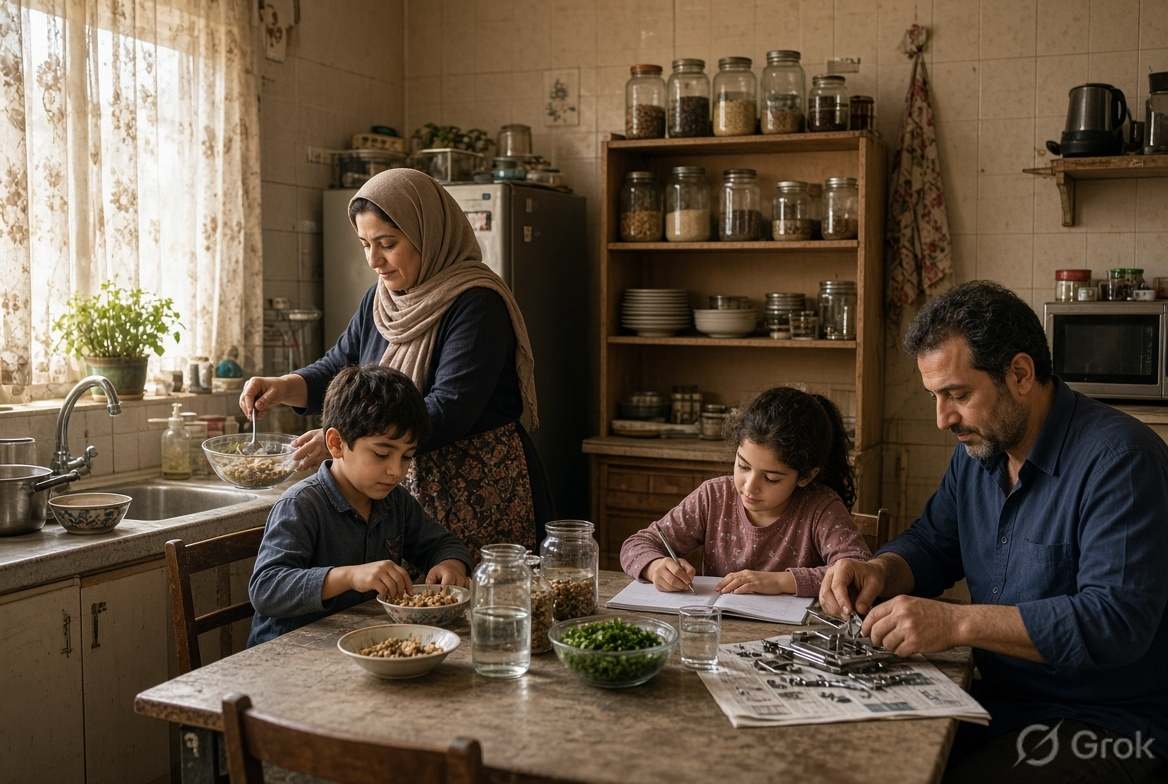
Economic crises are often measured through inflation rates, currency fluctuations, or GDP figures. But for millions of ordinary families, the real story unfolds inside homes, where every day becomes an exercise in stretching limited resources.
Across Iran, many households are adopting extraordinary survival strategies to cope with rising living costs and prolonged economic uncertainty. Families are reportedly selling personal belongings, renting out laptops, offering spare household items for temporary use, and even selling hair to generate additional income. These are not signs of changing consumer habits—they reflect how people adapt when traditional sources of financial stability become increasingly difficult to rely upon.
The emerging “survival economy” illustrates that during prolonged crises, economic resilience is often driven not by major policy changes but by the creativity and determination of ordinary citizens.
Survival Is Becoming an Everyday Financial Strategy
When incomes fail to keep pace with rising prices, households begin searching for alternative ways to earn money.
Items that were once considered personal possessions gradually become financial assets.
Unused electronics, furniture, clothing, jewelry, and household equipment can all provide temporary income through resale or rental.
Rather than waiting for economic conditions to improve, families are actively reshaping their finances using whatever resources remain available.
The Informal Economy Is Expanding
Periods of economic stress often encourage the growth of informal markets.
Individuals begin offering services, renting personal equipment, repairing used goods, or selling second-hand items through neighborhood networks and online platforms.
These activities help families generate income without requiring significant new investment.
Although often overlooked in official economic statistics, informal commerce plays an increasingly important role during periods of prolonged financial pressure.
Inflation Changes Consumer Behavior
Persistent inflation affects far more than prices.
It changes how people think about spending, saving, and ownership.
Households delay major purchases, repair items instead of replacing them, and increasingly prioritize essential expenses over discretionary spending.
Every financial decision becomes more deliberate because even small savings accumulate over time.
Economic uncertainty gradually reshapes everyday habits.
Education and Technology Become Shared Resources
Reports of families renting laptops illustrate another important trend.
Digital devices have become essential for education, employment, banking, and communication.
When purchasing new equipment becomes unaffordable, sharing or renting technology allows students and workers to remain connected despite financial constraints.
Access increasingly matters as much as ownership.
Human Capital Becomes an Economic Asset
One of the most striking examples of adaptation involves individuals selling their hair.
Although unusual, such decisions demonstrate how personal resources can become sources of income during periods of economic hardship.
Throughout history, communities facing financial crises have repeatedly transformed everyday assets into economic opportunities.
These choices often reflect necessity rather than preference.
Household Budgets Reflect National Economic Conditions
Macroeconomic policies eventually reach kitchen tables.
Inflation, currency depreciation, sanctions, employment conditions, and international trade all influence household purchasing power.
Families experience these broader economic forces through grocery bills, transportation costs, healthcare expenses, education fees, and housing payments.
Economic policy ultimately becomes personal.
Community Support Gains Importance
During difficult economic periods, families often rely more heavily on relatives, neighbors, and local communities.
Informal lending, shared childcare, cooperative purchasing, and mutual assistance help reduce financial pressure.
These social networks frequently become essential safety mechanisms when formal support systems face growing demand.
Community resilience complements individual resilience.
Economic Recovery Depends on Confidence
Financial recovery involves more than improving economic indicators.
Households need confidence that prices will stabilize, employment opportunities will improve, and future planning once again becomes possible.
Without that confidence, families may continue prioritizing survival strategies over investment and long-term spending.
Restoring optimism can therefore be just as important as restoring growth.
Resilience Has Limits
The adaptability shown by households is remarkable, but it should not be mistaken for an unlimited solution.
Selling personal possessions or renting essential equipment may provide temporary relief, yet these strategies rarely create lasting financial security.
Over time, opportunities to generate income from existing assets become increasingly limited.
Long-term economic stability ultimately depends on sustainable employment, stable prices, and broader improvements in the national economy.
The Bigger Picture
The reported experiences of Iranian families reveal an economy where resilience increasingly depends on individual ingenuity rather than financial comfort.
Selling personal belongings, renting household equipment, and finding new sources of income demonstrate the remarkable adaptability of ordinary people confronting prolonged economic uncertainty.
At the same time, these strategies also illustrate the hidden social cost of sustained financial pressure. Economic crises are not experienced only through national statistics; they reshape education, family decisions, consumption patterns, and everyday expectations about the future.
Ultimately, the story is not simply about hardship. It is about how communities respond when conventional economic pathways narrow. Families continue finding creative ways to support themselves, preserve opportunities for their children, and maintain dignity despite challenging circumstances.
Their experience serves as a reminder that the true strength of an economy is measured not only by production and growth but also by its ability to provide households with the stability, opportunity, and confidence needed to build a secure future.