
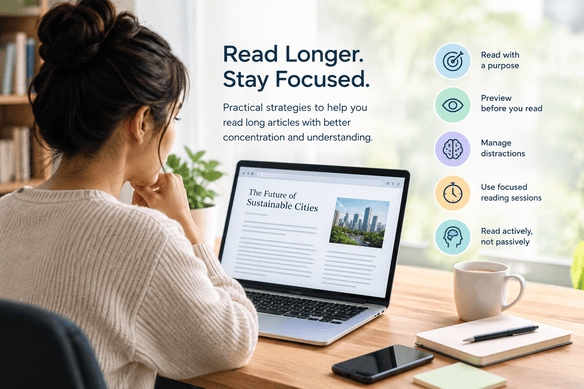
A long article can contain exactly the information you need, yet getting through it can feel surprisingly difficult. You start reading, check a notification, switch to another tab, return to the article, and realize you can no longer remember what the previous few paragraphs said.
The problem is not necessarily a lack of intelligence or discipline. Modern reading often takes place in environments filled with competing demands for attention. Recent research has found that attentional interference can negatively affect reading comprehension, while broader education data show that increased digitalisation, longer screen time and declining reading for enjoyment have occurred alongside weaker reading outcomes.
The good news is that reading long-form content effectively is a skill that can be developed. Rather than trying to concentrate through sheer willpower, readers can improve the way they approach an article, manage distractions and process information.
Why Long Articles Are So Easy to Interrupt
Digital reading offers convenience, but it also creates opportunities for interruption. A single screen may contain the article itself, notifications, email alerts, advertisements, social-media feeds, messages and links to other information.
Researchers studying digital reading have found that these interruptions can compete for limited attentional resources. A 2025 meta-analysis combining 124 experiments from 32 studies found that attentional interference in digital environments was associated with significantly poorer reading comprehension, with an overall Hedges’ g of −0.64.
Another study that examined reading in a more natural home environment found that participants reported attentional disruptions, on average, about every four minutes. The disruptions were often brief, but their frequency illustrates how difficult it can be to maintain an uninterrupted reading flow in a digital environment.
That does not mean digital reading is inherently bad. Research comparing digital and paper reading has produced more nuanced findings. What matters is often the combination of the reading task, the surrounding environment, the reader’s habits and the amount of competing attention. The practical lesson is simple: make important reading easier to focus on.
Start With a Purpose
One of the easiest ways to lose focus is to begin reading without knowing what you want to learn.
Before starting a long article, ask yourself one question:
What do I need from this?
Your answer might be a specific fact, an explanation of a concept, evidence for a decision or simply a general understanding of the subject.
Having a purpose gives your brain a reason to distinguish important information from background detail. It also changes how deeply you need to read. A technical article that you need to understand thoroughly deserves a different approach from a news analysis that you simply want to understand at a high level.
This does not mean skimming everything. It means matching your reading effort to your objective.
Preview the Article Before Reading It
Instead of immediately working through an article from the first sentence to the last, spend 30 seconds getting a sense of its structure.
Read the headline and introduction. Look at the subheadings. Notice charts, illustrations, highlighted statements or other visual cues. Then consider what the article appears to be arguing.
This quick preview creates a mental framework for the information that follows.
It can also prevent a common problem: spending several minutes reading a section that turns out not to be relevant to your purpose.
Think of the preview as looking at a map before beginning a journey. You still have to travel the route, but you have a better idea of where you are going.
Read in Meaningful Groups, Not One Word at a Time
Long articles become exhausting when every sentence feels like a series of individual words that must be processed separately.
A more efficient approach is to gradually learn to recognize groups of words and phrases as meaningful units. Instead of consciously processing:
“the / rapid / development / of / digital / technology”
you begin to recognize the phrase as one connected idea.
This type of reading can make the movement through a page smoother and reduce unnecessary pauses. The objective, however, should not be to race through the text. Reading speed is useful only when comprehension is preserved.
That is why structured training can be helpful for people who want to become more efficient readers. A modern speed reading app can, for example, provide controlled pacing exercises while allowing readers to monitor whether greater speed is actually accompanied by adequate comprehension.
The important distinction is between reading faster and simply reading recklessly. Faster reading with poor understanding is not an improvement.
Remove Distractions Before They Appear
It is much easier to protect your attention before reading than to repeatedly recover it after an interruption.
Put your phone somewhere outside your immediate reach. Silence non-essential notifications. Close unrelated browser tabs and avoid playing videos in the background. If the article is on a website filled with visual distractions, use a reader or full-screen mode where available.
This matters because distraction has a cognitive cost even when the interruption seems trivial.
Research on interruptions during digital reading has shown that readers often change their reading behavior after an interruption, including engaging in more rereading. The same research found that readers who reread were more successful in recovering comprehension.
In other words, losing your place is not just annoying. It can create additional work.
Use Focused Reading Sessions
You do not need to force yourself to remain intensely focused on a long article for an unlimited period.
Instead, divide difficult reading into manageable sessions. For example, you might spend 20 to 30 minutes reading without interruptions and then take a short break before continuing.
The exact duration is less important than the principle: protect periods of uninterrupted attention.
This approach is particularly useful for reports, academic material and long-form journalism, where comprehension matters more than simply reaching the end of the page.
A useful measure is not “How long did I read?” but “How much did I actually understand?”
Don’t Start the Whole Article Again When You Lose Focus
Everyone’s attention wanders occasionally. When it happens, the instinct is often to go back several paragraphs and start over.
That is not always necessary.
First identify where your understanding broke down. Then move back just far enough to reconnect with the argument and continue.
Research examining interruptions during digital reading found that rereading behavior can help readers recover comprehension after an interruption.
The goal is therefore not to achieve perfect concentration. It is to become better at recovering quickly when concentration is lost.
Read Actively, Not Passively
Another way to maintain attention is to interact mentally with what you are reading.
Ask questions such as:
- What is the author’s main argument?
- What evidence supports it?
- What is the most important point in this section?
- How does this information connect with what I already know?
At the end of a major section, try summarizing the point in one sentence without looking back at the screen.
This simple act of recall turns reading from passive exposure into active processing. It also gives you an immediate test of comprehension.
If you cannot explain what you just read in your own words, continuing to read faster is unlikely to solve the problem.
A Simple Five-Step Method for Long Articles
For readers who frequently struggle to finish long-form content, the process can be reduced to five steps:
1. Preview: Understand the article’s structure before diving in.
2. Set a purpose: Decide what you need to learn or accomplish.
3. Remove distractions: Create an environment where the article has your attention.
4. Control your pace: Read smoothly and efficiently without sacrificing understanding.
5. Recall: Pause occasionally and explain the main idea in your own words.
Together, these steps address both sides of effective reading: attention and comprehension.
What About Reading Speed?
There is a natural temptation to assume that the fastest reader is the most productive reader. That is not necessarily true.
If increasing speed causes comprehension to collapse, the extra words per minute have little practical value.
A better goal is to find a sustainable pace at which you can move through information efficiently while retaining the important ideas. Tools that measure both reading speed and comprehension can make this process more concrete. ReaderFLEX, for example, combines reading assessments with controlled pacing exercises and progress tracking rather than focusing on speed alone.
That distinction is increasingly important as people face larger volumes of digital information. The answer is not simply to consume more words per minute. It is to become better at deciding what deserves your attention and how deeply you need to process it.
The Bigger Lesson: Better Reading Is About Better Attention
Recent research does not support the simplistic idea that screens automatically make reading worse. Instead, the evidence points toward a more useful conclusion: digital reading becomes harder when attention is repeatedly divided.
The 2025 meta-analysis of digital-reading research found a substantial overall negative effect from attentional interference, while other research has demonstrated that the type and context of distraction matter.
That means readers have more control than they may think.
You cannot eliminate every notification, tempting link or moment of mind-wandering. But you can create better conditions for sustained reading, establish a clear purpose, control your pace and actively engage with what is on the page.
The result is not merely finishing long articles more quickly. It is being able to finish them with a clearer understanding of what you actually read.
In a world with more information competing for attention every day, that may be the more valuable reading skill of all.