
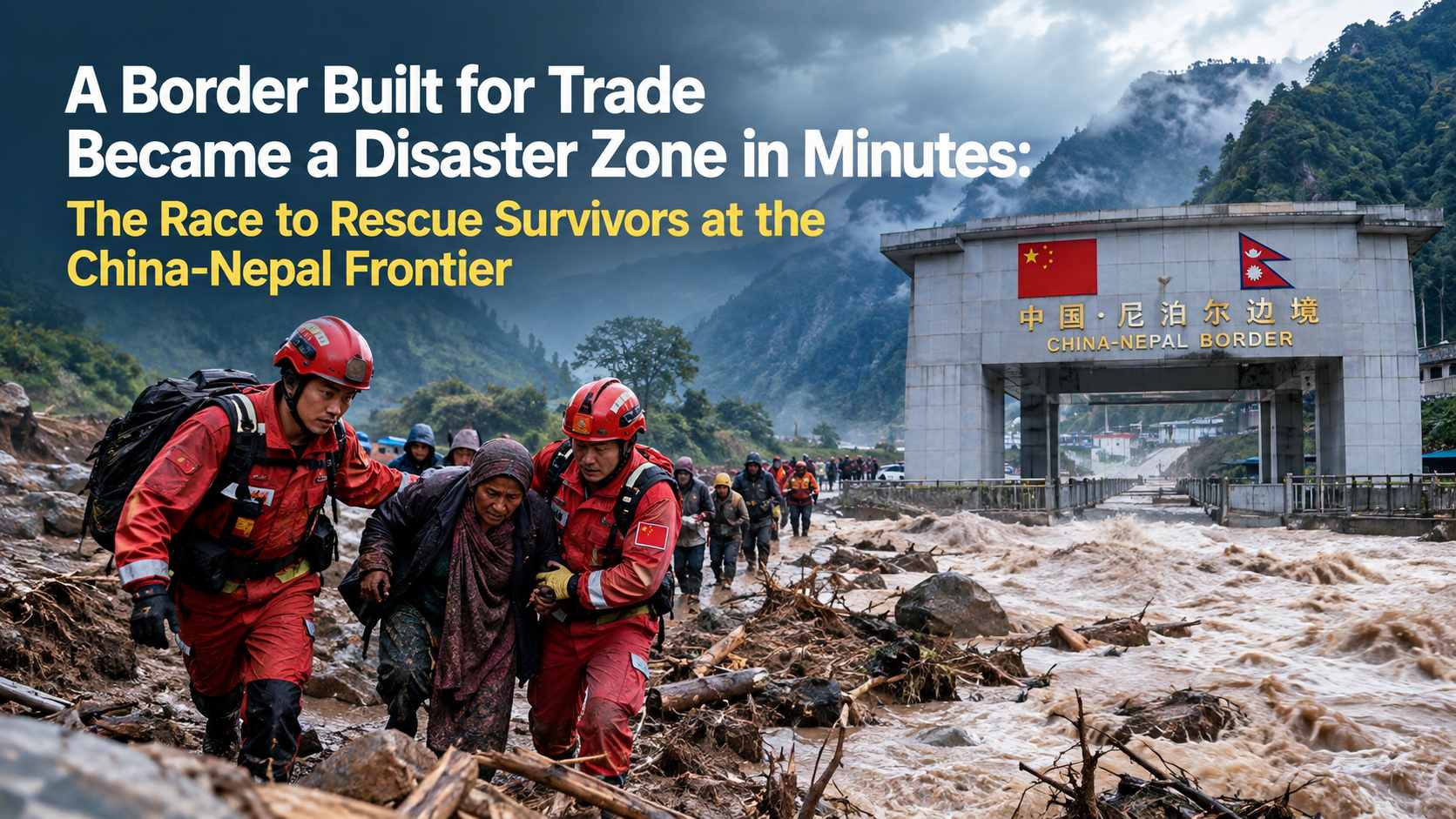
One moment, Gyirong Port was a busy gateway connecting China and Nepal.
The next, it was buried in chaos.
A devastating surge of water, mud, rock and debris swept through the Himalayan border region on August 26, leaving behind destroyed roads, shattered infrastructure and a desperate search for hundreds of missing people.
Now, on both sides of the border, rescue teams are racing against time.
What initially appeared to be a major mudslide has developed into a far larger cross-border disaster, with investigators and emergency authorities linking the catastrophe to a massive collapse of glacial ice and rock high in the Himalayas. The collapse unleashed a destructive flow that tore through the valleys below and devastated communities in both Nepal and China’s Xizang Autonomous Region.
A Disaster That Did Not Stop at the Border
The catastrophe began in the high mountains, but its impact quickly crossed an international border.
Gyirong Port, an important land crossing between China and Nepal, was among the areas hit. Roads were cut off, while power and communication links were disrupted.
Chinese authorities activated a Level-II emergency response and mobilised rescue teams, equipment and relief supplies. Teams have been working to search for missing people, clear blocked routes and assess the danger of further disasters.
The disaster shows how vulnerable Himalayan communities can be when a catastrophe begins far above them.
The mountain may be remote.
The impact is not.
Rescuers Face a Race Against Time
The search is being carried out in extremely difficult conditions.
Destroyed roads have made access to some areas difficult. Unstable terrain continues to threaten rescuers, while authorities remain concerned about secondary landslides and flooding.
As of the latest CGTN update on August 27, three people had been confirmed dead and 558 remained missing in Gyirong County on the Chinese side. The overall cross-border toll is much higher, with Nepal and China together reporting hundreds of deaths and more than 1,300 people missing as rescue operations continue.
But behind those numbers is a much more painful reality.
Every missing person is someone’s parent, child, friend or colleague.
And for families still waiting for news, the rescue operation is not simply an emergency response.
It is a race between hope and time.
The Mountains Are Still Dangerous
Finding survivors is only part of the challenge.
Rescue teams must also work in a landscape that remains unstable.
A barrier lake formed by debris upstream has raised fears of another destructive surge if water breaks through the blockage. Continued instability in the mountains also increases the risk of further landslides.
That means the disaster zone remains dangerous even after the first catastrophic wave has passed.
For emergency workers, the mission is therefore twofold:
Rescue the missing.
Prevent another disaster from taking more lives.
From a Local Emergency to an International Crisis
The disaster has also taken on an international dimension.
The affected Himalayan region attracts tourists, trekkers and pilgrims from around the world. Foreign nationals are among the missing, while international agencies and neighbouring countries have begun offering assistance.
The flood has also disrupted communities and infrastructure downstream, demonstrating how a single event in the Himalayas can affect areas far beyond the point where it began.
This is what makes the Himalayan disaster so significant.
It is not simply a tragedy confined to one village, one district or even one country.
It is a cross-border emergency unfolding across one of the world’s most fragile mountain regions.
The Bigger Warning From the Himalayas
The destruction at the China-Nepal border is also a reminder that disasters in the Himalayas are becoming increasingly complex.
Scientists are investigating the precise chain of events, but current reporting points to a major glacial collapse that triggered a powerful flood and debris flow. In a warming mountain environment, unstable glaciers and extreme events are becoming a growing concern for communities living downstream.
The challenge is not only predicting when disaster will strike.
It is ensuring that people living far below unstable mountain zones have enough warning when it does.
Because in this case, the border was not a barrier.
Water, mud and debris moved across the region with devastating force.
The Search Continues
For now, the most urgent task is clear.
Search for survivors.
Reach isolated communities.
Restore communication.
Treat the injured.
And prevent further tragedy.
The disaster at Gyirong Port began as a sudden catastrophe in the mountains.
But it has become something much larger—a humanitarian crisis that has brought China, Nepal and the international community into a shared emergency.
The final number of lives lost is still unknown.
The search continues.
And somewhere beneath the mud, behind blocked roads and in isolated valleys, rescuers are still looking for signs of life.
**In the Himalayas, where disaster can arrive in minutes, every hour