
For millions of European families, the question of when a child should be allowed to create a social-media account could soon have a very different answer.
The European Union is preparing new rules aimed at limiting children’s independent access to social media, video-sharing platforms, AI chatbots and certain online games. The proposed EU Kids Act would establish age-based protections designed to keep younger children away from services considered unsuitable or potentially harmful.
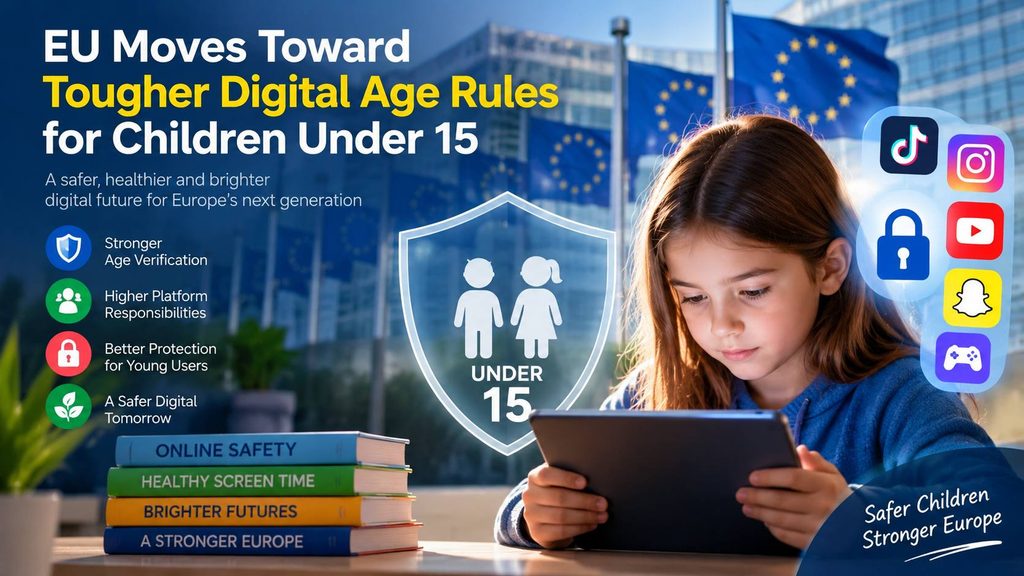
But this is about more than simply telling children to stay off Instagram, TikTok or YouTube.
The bigger idea is to change who carries responsibility for keeping children safe online.
Instead of expecting parents to monitor every app, account and algorithm their children encounter, the EU wants digital platforms to take a much greater role in preventing children from being exposed to harmful online experiences.
A New Digital Age Line at 15
Under the proposed framework, children would gradually receive greater online access as they get older.
Children under three would have no access to the covered services. Those aged three to 12 would be directed toward child-friendly, parent-controlled services, while teenagers aged 13 and 14 could potentially use limited introductory accounts under strict parental controls.
At 15, young people would be able to create their own accounts without the same level of parental control.
That would create a significant change from today’s system, where many major platforms set their minimum user age at 13 but enforcement can be inconsistent.
The EU’s proposed approach would make age restrictions much harder to ignore.
How Would Platforms Know a User’s Age?
This is where technology becomes central to the plan.
Platforms would be expected to introduce age-verification mechanisms so they can determine whether a user falls within an age-restricted category.
The European Commission has already been developing an age-verification system designed to let people prove their age without unnecessarily revealing other personal information. The system is intended to be privacy-preserving and can be adapted to verify different age thresholds.
That could be particularly important because simply asking someone to enter a birth date has obvious limitations.
A child can easily type a different year of birth.
The EU’s challenge is therefore to create a system that can distinguish between age groups while avoiding the creation of another enormous database containing people’s personal information.
Social Media Is Only Part of the Plan
The proposed rules extend beyond conventional social-media platforms.
AI chatbots, video-sharing services and online games are also part of the wider discussion.
That reflects how quickly children’s digital habits have changed.
A decade ago, concerns about young users largely centered on Facebook, Instagram and similar networks. Today, children interact with recommendation algorithms, AI assistants, livestreams, online games and virtual communities.
The EU’s approach attempts to address that wider digital environment rather than treating social media as an isolated problem.
The EU Wants to Tackle Addictive Design
Another major element of the proposal is the design of online services themselves.
The EU wants platforms to reduce features that can encourage excessive use, including mechanisms such as infinite scrolling and certain types of notifications.
The argument is that protecting children is not only about controlling what they see. It is also about examining how platforms are designed to keep users engaged.
That distinction could have significant consequences for technology companies.
If regulators increasingly focus on platform design, companies may have to reconsider some of the features that have become standard across social-media applications.
Parents Would Still Have a Major Role
The proposal does not remove parents from the equation.
Instead, parental controls would become an important part of the system, particularly for younger teenagers.
Parents could have greater control over what their children access, while platforms would be expected to provide stronger default protections.
The EU’s earlier policy work has also emphasized privacy-by-default for minors and tools that allow parents and children to manage online risks.
In effect, Brussels is trying to create several layers of protection rather than relying on a single age limit.
Why the EU Is Taking Action
The push comes amid growing concern about cyberbullying, online predators, harmful content, addictive algorithms and other risks affecting young users.
The European Commission has said that almost all young people in the EU use the internet daily and that social media is an important source of information for younger Europeans. At the same time, it has identified cyberbullying and exposure to harmful content as significant concerns.
The EU is therefore attempting to strike a difficult balance.
Children need the internet for education, communication and creativity, but policymakers also want to reduce exposure to online environments that may put younger users at risk.
Technology Companies Could Face New Responsibilities
If the proposal eventually becomes law, the burden would shift further toward the platforms themselves.
Companies would be expected to implement age checks, parental controls, safer default settings and systems for reporting harmful material.
Large technology companies could also face additional supervisory obligations and fees under the proposed framework.
This represents an important change in philosophy.
Instead of asking parents to constantly chase after new apps and digital trends, regulators want companies to build child safety into their products from the beginning.
But the Proposal Still Has to Become Law
The proposed rules are not automatically law simply because the European Commission presents them.
They will have to go through negotiations involving the European Parliament and EU member states. The details could therefore change before a final version is approved.
That means the proposed age thresholds and specific requirements should not yet be treated as final rules applying across the entire EU.
Some European countries are already moving independently in this direction.
France, for example, has approved legislation establishing a social-media age limit of 15, making it the first EU country to take such a step at national level.
Privacy Is the Complicated Part
There is an obvious question behind any age-verification system:
How do you prove someone’s age without collecting too much information about them?
The EU says its approach should preserve privacy by allowing users to prove that they meet an age requirement without revealing unnecessary personal details. Its age-verification system is designed around anonymous proof-of-age principles.
But implementing such systems across thousands of digital services will still be technically and legally complicated.
A system that is too weak could be easy to bypass.
A system that collects too much information could create new privacy concerns.
Finding the right balance may be one of the most difficult parts of the entire project.
The Debate Goes Beyond Screen Time
The proposal also raises a larger question about childhood in the digital age.
For many children, the internet is no longer something they occasionally visit. It is where they communicate with friends, watch entertainment, learn new things, play games and increasingly interact with AI.
That makes restricting access very different from simply banning a traditional product.
The EU is effectively asking whether children should have the same digital freedom as adults—and, if not, where the line should be drawn.
A Potential New Model for Child Safety Online
If adopted, the EU’s approach could become a major test case for other countries.
Australia has already introduced restrictions on social-media access for children under 16, while several European governments are considering their own age limits.
The European model could therefore influence how governments around the world approach children’s access to social media and other digital services.
But its success will depend on more than the number written into the law.
The technology will have to work. Platforms will have to comply. Parents will need usable controls. And children will need safe alternatives rather than simply being pushed away from digital spaces.
The Real Battle May Be Over Who Controls the Digital Childhood
The EU’s proposed rules represent a much broader shift than a simple restriction on social-media accounts.
They suggest that governments increasingly see children’s online experiences as something that platforms must actively design for safety—not something parents alone should police.
If the EU succeeds in implementing the framework, a child’s age could become a much more important factor in determining what they can access online.
The biggest change, however, may be philosophical.
For years, the internet largely operated on the assumption that users should adapt to technology.
The EU is now pushing a different idea: technology should adapt to the needs and vulnerabilities of children.
Whether that approach ultimately becomes the new standard will depend on the legislation still to come, but the direction of travel is becoming increasingly clear: Europe’s digital future may come with a much stronger age barrier between children and the adult internet.