
Every day, we read more than we realize.
We read emails before work, reports during meetings, news articles during breaks, messages throughout the day and research when we need to learn something new. For many people, the limitation is not access to information. It is the amount of time and attention available to process it.
This is where reading speed becomes interesting.
Learning to read faster is not about racing through pages or trying to reach an unrealistic number of words per minute. Research on reading rates shows that average adult silent reading in English is much more moderate than many popular speed-reading claims suggest, with an average of about 238 words per minute for non-fiction. Extremely high speeds generally come with significant losses in understanding.
The real value of improving reading speed is therefore more practical: becoming more efficient at processing written information while maintaining an appropriate level of comprehension.
That change can influence far more than the number of books you finish.
More Time for Learning and Personal Growth
One of the clearest benefits of becoming a more efficient reader is having more time to learn.
Imagine spending 30 minutes reading every evening. A modest improvement in reading efficiency could allow you to move through more material during the same period, making it easier to explore books, essays, research and other subjects that interest you.
This matters because reading is closely connected with lifelong learning. The OECD describes reading literacy not simply as decoding words, but as understanding, evaluating, reflecting on and using texts to achieve personal objectives and build knowledge.
A faster, more controlled reading pace can make learning feel less demanding. Instead of looking at a long book and thinking about how many hours it will take to finish, you can focus more easily on the ideas you want to absorb.
That can encourage a useful cycle:
read more → learn more → become more curious → read more.
It Can Make Information Overload Feel More Manageable
Modern life brings an enormous amount of written information.
Newsletters, online articles, product documentation, research papers, workplace updates and digital messages can quickly become an overwhelming stream. The problem is not necessarily that any individual piece is difficult. It is the sheer volume.
Developing stronger reading habits can help you become more selective and efficient.
Rather than giving every sentence the same amount of attention, you can learn to identify the main argument, recognize supporting information and slow down when material becomes technically or conceptually demanding.
This distinction is important. Good reading is not always fast reading.
Sometimes the most efficient reader is the person who knows when to speed up and when to slow down.
A More Efficient Workday
The professional benefits can be even more tangible.
Consider how much written material an employee may encounter in a normal week: internal emails, contracts, presentations, reports, proposals, meeting notes, technical documentation and industry news.
If reading is consistently slow or easily interrupted, these tasks can consume a significant portion of the working day.
Improving reading efficiency does not eliminate the need for careful reading. Instead, it can make routine information processing less time-consuming.
For example, an experienced reader may quickly identify the sections of a report that require detailed attention while moving more quickly through background information. When working with complex material, the reader can deliberately reduce pace rather than applying the same speed everywhere.
This is more useful than chasing a single words-per-minute target.
Faster Reading Can Support Better Professional Learning
Career development increasingly depends on the ability to learn continuously.
Industries change. New tools emerge. Regulations evolve. Competitors introduce new products. Professionals who want to remain effective often have to absorb new information long after formal education has ended.
The challenge is that professional learning competes with an already crowded schedule.
A more efficient reading process can make it easier to fit learning into that schedule. A report that once seemed too long for a lunch break may become manageable. A research paper can be reviewed more efficiently before a meeting. A new subject can be explored without requiring hours of uninterrupted study.
This is particularly relevant in a digital environment where the ability to find, evaluate and integrate information has become an important part of literacy itself. The OECD notes that modern reading requires readers to navigate ambiguity, distinguish fact from opinion and evaluate information across digital sources.
It Can Change Your Relationship With Books
There is also a personal benefit that is easy to overlook.
People often accumulate books they genuinely want to read but never seem to have enough time for them. A growing reading list can eventually become another source of pressure.
Becoming a more efficient reader can make reading feel more accessible.
Instead of wondering whether you have enough time to read a particular book, you can approach it in smaller, consistent sessions. Over time, those sessions add up.
The goal should not be to finish books merely to increase the number on a reading list. It should be to make reading a more practical part of everyday life.
Research also suggests that reading for enjoyment is associated with better reading performance. In its analysis of reading literacy, the OECD reports a positive association between reading enjoyment and reading performance across participating countries.
Reading Faster Can Build Confidence
There is a psychological benefit to becoming comfortable with substantial amounts of text.
A person who struggles with long reports may begin avoiding them. Someone who feels overwhelmed by a long research article may rely on summaries without ever engaging with the original material.
As reading becomes more manageable, that hesitation can decrease.
You may feel more comfortable opening a lengthy report, exploring an unfamiliar subject or reading a detailed analysis because the volume of text no longer feels like an immediate obstacle.
This is where structured practice can be useful. Some readers use a speed reading app or similar training tool to work on pacing, visual processing and comprehension in a controlled environment. The purpose should be skill development, not simply pushing the reading rate higher and higher.
The Professional Advantage of Knowing When to Slow Down
One of the biggest misconceptions about speed reading is that faster is always better.
It is not.
Reading a familiar news article, for example, can require less effort than reading a legal agreement, scientific paper or technical manual. Trying to read both at the same speed may actually be counterproductive.
Scientific research on reading rates supports this more flexible view. Reading involves limits in visual and language processing, which means very high rates cannot be achieved while preserving full understanding of ordinary text.
The more valuable skill is therefore pace control.
You want to move quickly through information when the material is straightforward, slow down when an idea needs deeper processing and reread when comprehension breaks down.
That is a skill that can transfer directly into professional life.
Better Reading Is About More Than Speed
Today’s information environment makes reading literacy increasingly important. The latest PISA 2025 results from the OECD report a substantial decline in reading performance across OECD countries between 2015 and 2025, while also noting major changes in how young people interact with digital information. The OECD is careful to point out that these trends do not establish a simple cause-and-effect relationship between digital activity and declining reading performance.
The lesson is not that everyone needs to become a speed reader.
Instead, it is that readers need to become more capable, deliberate and adaptable.
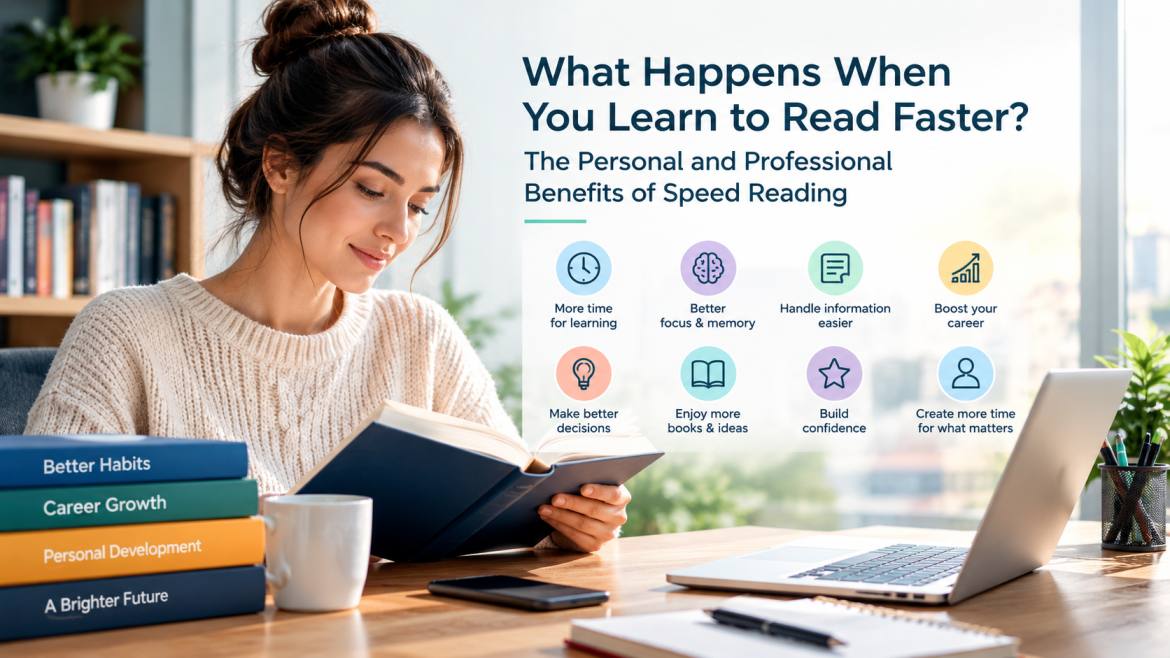
Reading faster can help create more time for learning. It can make large amounts of information feel less intimidating. It can support professional development and make books, reports and articles easier to fit into a busy life.
But speed should always serve understanding.
The ultimate goal is not to read the most words. It is to process useful information efficiently, understand what matters and have enough time left to put that knowledge to work.
That is when faster reading becomes more than a reading trick. It becomes a practical life skill.