A conflict thousands of kilometres away is forcing Pakistan to confront a problem that can be felt on its roads, in government offices and potentially inside households: how to make limited fuel supplies last longer.
As the West Asia conflict continues to disrupt energy markets and put pressure on global oil supplies, Pakistan is considering a package of fuel-saving measures being described as a possible “petroleum smart lockdown.”
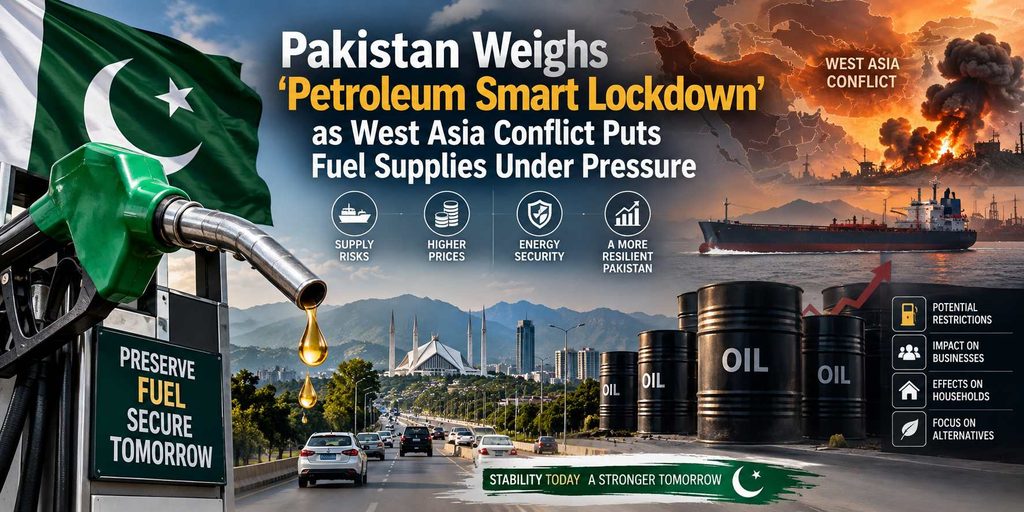
The proposal is not the same as the sweeping COVID-era lockdowns that brought everyday life to a standstill. Instead, the idea is to selectively reduce activities that consume large amounts of petrol and diesel while keeping essential services running.
That distinction could become increasingly important if international energy disruptions continue.
Why Pakistan Is Looking at Fuel Restrictions
Pakistan is particularly exposed to movements in international oil prices because the country depends heavily on imported petroleum.
The latest escalation in West Asia has created additional uncertainty around oil production, shipping routes and fuel supplies. The International Energy Agency has warned that global oil supply conditions have tightened significantly amid disruptions linked to conflicts in the Middle East and elsewhere.
For Pakistan, higher international prices create pressure on both the government and consumers.
Every increase in the cost of imported fuel can affect transportation, electricity generation, manufacturing and the prices of goods moved across the country.
That is why Islamabad is examining ways to reduce consumption rather than simply allowing demand to continue rising.
What Could a “Smart Lockdown” Look Like?
The term may sound dramatic, but the measures under discussion are more targeted than a conventional lockdown.
Possible steps include reducing fuel allowances for official vehicles, encouraging work-from-home arrangements, changing working schedules and limiting unnecessary travel.
Recent reporting has also pointed to proposals involving cuts in official fuel use and other austerity measures.
The underlying principle is simple: if the country cannot immediately increase its fuel supply, it can try to reduce how quickly it consumes what it already has.
It is similar to stretching a household budget when income suddenly falls. Instead of eliminating every expense, people first look for areas where spending can be reduced without affecting essential needs.
Pakistan is now facing a similar calculation at a national level.
Government Vehicles Could Become an Early Target
One area receiving attention is the use of fuel by government departments.
Reducing official fuel allowances or restricting the use of government vehicles could provide a relatively direct way of cutting consumption.
Such measures would also send a public signal that the government is attempting to conserve resources during an energy crunch.
Reports have indicated that a significant reduction in fuel allowances for official vehicles is among the measures under consideration.
Whether such restrictions are implemented, and how strictly they are enforced, will determine how much fuel they actually save.
Working From Home Could Return as a Fuel-Saving Tool
Another possible measure is a greater reliance on remote work.
During the COVID-19 pandemic, working from home became a public-health necessity. Now, Pakistan could potentially use a similar arrangement for a very different reason: reducing daily commuting and therefore petroleum consumption.
Fewer employees travelling to offices means fewer cars, motorcycles and buses on the road.
Even a limited reduction in commuting could translate into lower fuel demand when applied across large government departments and other organizations.
However, remote work is not practical for every occupation. Hospitals, factories, transport services, shops and many other businesses still require employees to be physically present.
That means any fuel-saving work policy would likely have to be selective.
The Economic Pressure Goes Beyond Petrol Pumps
The consequences of expensive oil do not stop at fuel stations.
When diesel becomes more expensive, transporting food, construction materials and manufactured products can cost more. Businesses may then face higher operating expenses, while consumers can eventually see those costs reflected in prices.
Industries that depend heavily on fuel can also come under pressure.
This creates a chain reaction:
Higher oil costs → higher transportation costs → higher business expenses → greater pressure on consumer prices.
For a country already dealing with economic challenges, preventing that chain from becoming worse is a major concern.
Why the West Asia Conflict Matters to Pakistan
Pakistan’s vulnerability is also connected to its geographical and economic relationship with the Gulf region.
The country’s energy security depends substantially on imported supplies, making disruptions to major shipping routes particularly important.
Recent developments have already caused significant volatility in global oil markets. Reuters reported that disruptions affecting Saudi oil infrastructure and regional shipping routes have added to concerns about global supply.
The longer such disruptions continue, the more difficult it becomes for countries that rely heavily on imports to shield consumers from international price movements.
This Is Not Yet a Nationwide Lockdown
One of the most important points for readers is the difference between a proposal for targeted fuel conservation and an actual nationwide lockdown.
Pakistan has previously introduced emergency austerity measures during periods of severe energy pressure, including reduced working schedules and restrictions intended to conserve fuel and energy.
But the current discussion should not automatically be interpreted as a return to COVID-style restrictions.
The concept of a “smart lockdown” is better understood as a collection of measures designed to reduce unnecessary petroleum consumption while allowing essential economic activity to continue.
Whether Pakistan ultimately adopts the full package remains dependent on the government’s assessment of fuel availability, international oil prices and the continuing situation in West Asia.
The Real Test Will Be Everyday Life
The biggest question is not what the policy is called.
It is whether ordinary people notice its effects.
If government offices reduce working days, businesses may have to adjust schedules. If official vehicles face stricter fuel limits, government operations could change. If commuting is reduced, transport demand could fall.
But if restrictions become too broad, businesses and workers could face additional difficulties.
That leaves policymakers with a difficult balancing act: save fuel without unnecessarily slowing an already pressured economy.
Pakistan Faces a Choice Between Conservation and Disruption
The discussion over a petroleum “smart lockdown” illustrates how quickly an international conflict can move from foreign-policy headlines into domestic economic decisions.
The immediate issue is fuel, but the broader challenge is energy security.
Pakistan cannot control the course of the conflict in West Asia or the movement of global oil prices. What it can control, to some extent, is how efficiently it uses the fuel available to it.
For now, the proposed measures remain part of a wider effort to prepare for continued pressure on petroleum supplies.
If the regional crisis persists, however, conserving fuel may become less of an emergency response and more of a necessity.
The question facing Pakistan is therefore not simply whether it needsA conflict thousands of kilometres away is forcing Pakistan to confront a problem that can be felt on its roads, in government offices and potentially inside households: how to make limited fuel supplies last longer.
As the West Asia conflict continues to disrupt energy markets and put pressure on global oil supplies, Pakistan is considering a package of fuel-saving measures being described as a possible “petroleum smart lockdown.”
The proposal is not the same as the sweeping COVID-era lockdowns that brought everyday life to a standstill. Instead, the idea is to selectively reduce activities that consume large amounts of petrol and diesel while keeping essential services running.
That distinction could become increasingly important if international energy disruptions continue.
Why Pakistan Is Looking at Fuel Restrictions
Pakistan is particularly exposed to movements in international oil prices because the country depends heavily on imported petroleum.
The latest escalation in West Asia has created additional uncertainty around oil production, shipping routes and fuel supplies. The International Energy Agency has warned that global oil supply conditions have tightened significantly amid disruptions linked to conflicts in the Middle East and elsewhere.
For Pakistan, higher international prices create pressure on both the government and consumers.
Every increase in the cost of imported fuel can affect transportation, electricity generation, manufacturing and the prices of goods moved across the country.
That is why Islamabad is examining ways to reduce consumption rather than simply allowing demand to continue rising.
What Could a “Smart Lockdown” Look Like?
The term may sound dramatic, but the measures under discussion are more targeted than a conventional lockdown.
Possible steps include reducing fuel allowances for official vehicles, encouraging work-from-home arrangements, changing working schedules and limiting unnecessary travel.
Recent reporting has also pointed to proposals involving cuts in official fuel use and other austerity measures.
The underlying principle is simple: if the country cannot immediately increase its fuel supply, it can try to reduce how quickly it consumes what it already has.
It is similar to stretching a household budget when income suddenly falls. Instead of eliminating every expense, people first look for areas where spending can be reduced without affecting essential needs.
Pakistan is now facing a similar calculation at a national level.
Government Vehicles Could Become an Early Target
One area receiving attention is the use of fuel by government departments.
Reducing official fuel allowances or restricting the use of government vehicles could provide a relatively direct way of cutting consumption.
Such measures would also send a public signal that the government is attempting to conserve resources during an energy crunch.
Reports have indicated that a significant reduction in fuel allowances for official vehicles is among the measures under consideration.
Whether such restrictions are implemented, and how strictly they are enforced, will determine how much fuel they actually save.
Working From Home Could Return as a Fuel-Saving Tool
Another possible measure is a greater reliance on remote work.
During the COVID-19 pandemic, working from home became a public-health necessity. Now, Pakistan could potentially use a similar arrangement for a very different reason: reducing daily commuting and therefore petroleum consumption.
Fewer employees travelling to offices means fewer cars, motorcycles and buses on the road.
Even a limited reduction in commuting could translate into lower fuel demand when applied across large government departments and other organizations.
However, remote work is not practical for every occupation. Hospitals, factories, transport services, shops and many other businesses still require employees to be physically present.
That means any fuel-saving work policy would likely have to be selective.
The Economic Pressure Goes Beyond Petrol Pumps
The consequences of expensive oil do not stop at fuel stations.
When diesel becomes more expensive, transporting food, construction materials and manufactured products can cost more. Businesses may then face higher operating expenses, while consumers can eventually see those costs reflected in prices.
Industries that depend heavily on fuel can also come under pressure.
This creates a chain reaction:
Higher oil costs → higher transportation costs → higher business expenses → greater pressure on consumer prices.
For a country already dealing with economic challenges, preventing that chain from becoming worse is a major concern.
Why the West Asia Conflict Matters to Pakistan
Pakistan’s vulnerability is also connected to its geographical and economic relationship with the Gulf region.
The country’s energy security depends substantially on imported supplies, making disruptions to major shipping routes particularly important.
Recent developments have already caused significant volatility in global oil markets. Reuters reported that disruptions affecting Saudi oil infrastructure and regional shipping routes have added to concerns about global supply.
The longer such disruptions continue, the more difficult it becomes for countries that rely heavily on imports to shield consumers from international price movements.
This Is Not Yet a Nationwide Lockdown
One of the most important points for readers is the difference between a proposal for targeted fuel conservation and an actual nationwide lockdown.
Pakistan has previously introduced emergency austerity measures during periods of severe energy pressure, including reduced working schedules and restrictions intended to conserve fuel and energy.
But the current discussion should not automatically be interpreted as a return to COVID-style restrictions.
The concept of a “smart lockdown” is better understood as a collection of measures designed to reduce unnecessary petroleum consumption while allowing essential economic activity to continue.
Whether Pakistan ultimately adopts the full package remains dependent on the government’s assessment of fuel availability, international oil prices and the continuing situation in West Asia.
The Real Test Will Be Everyday Life
The biggest question is not what the policy is called.
It is whether ordinary people notice its effects.
If government offices reduce working days, businesses may have to adjust schedules. If official vehicles face stricter fuel limits, government operations could change. If commuting is reduced, transport demand could fall.
But if restrictions become too broad, businesses and workers could face additional difficulties.
That leaves policymakers with a difficult balancing act: save fuel without unnecessarily slowing an already pressured economy.
Pakistan Faces a Choice Between Conservation and Disruption
The discussion over a petroleum “smart lockdown” illustrates how quickly an international conflict can move from foreign-policy headlines into domestic economic decisions.
The immediate issue is fuel, but the broader challenge is energy security.
Pakistan cannot control the course of the conflict in West Asia or the movement of global oil prices. What it can control, to some extent, is how efficiently it uses the fuel available to it.
For now, the proposed measures remain part of a wider effort to prepare for continued pressure on petroleum supplies.
If the regional crisis persists, however, conserving fuel may become less of an emergency response and more of a necessity.
The question facing Pakistan is therefore not simply whether it needs a “smart lockdown.” It is how much economic activity can be maintained while making every litre of fuel go further.