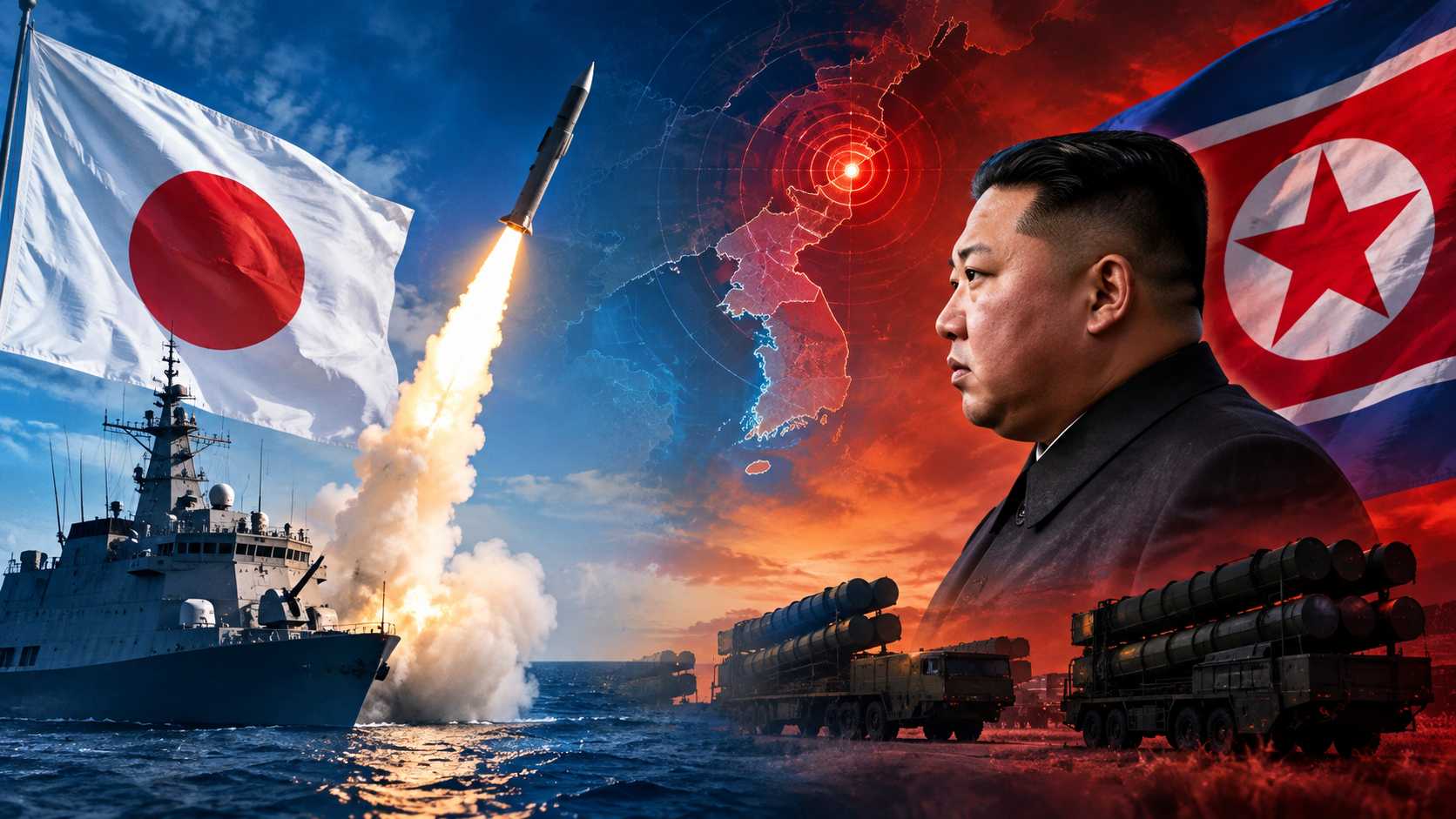
Japan’s first test-firing of a U.S.-made Tomahawk cruise missile was intended to demonstrate a stronger ability to deter attacks. North Korea interpreted it very differently.
Kim Yo Jong, the influential sister of North Korean leader Kim Jong Un, warned that Pyongyang would consider “additional military options” in response to what she described as Japan’s transformation into a power capable of carrying out pre-emptive and overseas strikes.
Her statement followed Japan’s launch of the long-range missile from the Aegis destroyer JS Chokai during multinational exercises involving the United States and the Philippines. The test represented an important milestone in Tokyo’s effort to develop what it calls counterstrike capabilities—the ability to hit missile-launch sites or other military targets if an attack against Japan appears imminent.
The exchange reveals a growing danger across Northeast Asia. Every country says it is strengthening its military for defensive reasons, yet each new deployment is interpreted by its rivals as preparation for aggression.
The Missile Test Marks a Major Change for Japan
For decades after World War II, Japan maintained a military posture centered on immediate territorial defense.
The acquisition of Tomahawk missiles represents a significant expansion of that approach.
Tomahawks can travel long distances and strike land-based targets with precision. Their inclusion in Japan’s arsenal gives Tokyo options that extend beyond intercepting incoming missiles after they have already been launched.
Japanese officials argue that this capability is necessary because North Korea possesses hundreds of missiles capable of reaching Japanese territory, while China and Russia continue expanding their regional military activity.
From Tokyo’s perspective, the new weapons are intended to strengthen deterrence rather than enable offensive war.
North Korea Sees an Offensive Capability
Pyongyang rejects Japan’s explanation.
Kim Yo Jong argued that long-range strike weapons cannot be separated from their potential offensive use. She portrayed Japan’s military modernization as evidence that the country is moving beyond the limits traditionally associated with its post-war defense policy.
North Korea also criticized Washington for supplying the weapons and helping Japan develop the ability to operate them.
This reflects Pyongyang’s broader position that U.S.-led military cooperation in the region poses a direct threat to North Korean security.
“Additional Military Options” Remains Deliberately Vague
Kim did not specify what North Korea might do in response.
That ambiguity is probably intentional.
Possible actions could include missile tests, military exercises, weapons demonstrations, or further development of systems intended to penetrate Japanese and American defenses. However, no particular response had been officially announced.
Vague threats allow Pyongyang to create uncertainty without committing itself to a fixed course of action.
They also place psychological and political pressure on Japan, South Korea, and the United States as they attempt to determine whether the statement is primarily rhetorical or a warning of an imminent weapons test.
Japan Says the Threat Already Exists
Tokyo’s defense planning is heavily influenced by North Korea’s continuing missile and nuclear development.
Japanese defense assessments state that Pyongyang possesses numerous ballistic missiles capable of reaching almost every part of Japan. North Korea has also tested cruise missiles, tactical ballistic missiles, and weapons launched from naval platforms.
From Japan’s perspective, waiting until an incoming missile is airborne may provide too little time to respond.
The counterstrike strategy is meant to convince a potential attacker that launching missiles against Japan could result in the destruction of military facilities used to support the attack.
The Region Is Trapped in a Security Dilemma
The confrontation illustrates what international-relations scholars call a security dilemma.
One country strengthens its military because it feels vulnerable. Its rival sees that buildup as threatening and responds by expanding its own forces. The first country then interprets that response as proof that its original concerns were justified.
Japan says Tomahawks are necessary because of North Korean missiles.
North Korea says more weapons are necessary because Japan now has Tomahawks.
Both sides describe their actions as defensive, but the result is an accelerating arms competition in which every new capability creates pressure for another response.
The United States Is Central to Japan’s Transformation
Japan’s military modernization is closely connected to its alliance with Washington.
The United States supplies weapons, shares intelligence, participates in joint exercises, and maintains forces throughout Japan. Washington and Tokyo are also strengthening their command structures to improve coordination during regional emergencies.
North Korea recently criticized the expansion of U.S. Forces Japan, portraying it as evidence that Washington is building a stronger regional war command.
For Japan, closer integration with the United States strengthens deterrence.
For North Korea, it makes Japan appear increasingly involved in American military planning for the Korean Peninsula and wider Indo-Pacific.
The Philippines Exercise Adds a Wider Regional Dimension
Japan’s missile test occurred during exercises involving the Philippines, another U.S. ally expanding defense cooperation in response to regional maritime tensions.
This matters because Japan’s security policy is no longer developing only within a bilateral alliance with Washington.
Tokyo is building a broader network of defense relationships involving the Philippines, Australia, South Korea, and other regional partners.
Supporters argue that these partnerships help preserve stability and freedom of navigation.
Beijing and Pyongyang often describe the same network as an attempt to contain them through an expanding U.S.-led security bloc.
Long-Range Missiles Complicate Crisis Management
Weapons capable of striking distant targets create difficult questions during a fast-moving crisis.
A government may say it intends to attack only after detecting clear preparations by an adversary. Yet intelligence is rarely perfect, and military movements can be interpreted in different ways.
A missile deployment presented as defensive preparation could be mistaken for the beginning of an attack.
The shorter the decision-making window becomes, the greater the risk that leaders act on incomplete information.
Counterstrike weapons may strengthen deterrence, but they also increase the importance of reliable intelligence, communication channels, and clear rules governing their use.
Japan’s Pacifist Identity Is Being Redefined
Japan’s constitution renounces war, and its military is formally known as the Self-Defense Forces.
The government argues that counterstrike capabilities remain consistent with this framework because they would be used only when an attack is underway or judged unavoidable.
Critics inside and outside Japan question whether long-range offensive weapons stretch the meaning of self-defense too far.
The debate is therefore not merely technical. It concerns how Japan interprets the political and legal identity it adopted after World War II.
North Korea Uses External Threats to Justify Its Arsenal
Pyongyang has repeatedly described American, Japanese, and South Korean military cooperation as justification for its nuclear and missile programs.
Each new exercise or weapons deployment is presented domestically as evidence that North Korea must maintain a powerful deterrent.
This narrative allows the leadership to portray continued military spending as a necessary response to external hostility rather than an independent policy choice.
The danger is that reciprocal military actions make diplomatic restraint increasingly difficult to defend on either side.
Diplomacy Has Fallen Behind Military Modernization
While military capabilities are expanding rapidly, political dialogue remains limited.
Japan and North Korea still have unresolved disputes involving Pyongyang’s nuclear and missile programs and the fate of Japanese citizens abducted by North Korean agents decades ago.
Previous Japanese governments explored the possibility of direct talks, but sustained diplomatic progress has remained elusive.
Without reliable communication, military signals carry greater risk because neither side can easily clarify intentions during a crisis.
The Real Test Is Whether Deterrence Prevents or Provokes
Japan’s leaders believe stronger strike capabilities will make North Korea and other potential adversaries less likely to attack.
That outcome is possible.
Yet deterrence succeeds only when opponents understand the capability, believe the threat is credible, and remain convinced that restraint is safer than escalation.
If North Korea instead interprets Japan’s buildup as preparation for pre-emptive war, it may place more missiles on alert, disperse launchers, shorten decision times, or conduct additional tests.
The same weapon can therefore produce stability or instability depending on how it is perceived.
The Bigger Perspective
Kim Yo Jong’s warning should not be viewed simply as another exchange of hostile rhetoric.
It reflects a deeper transformation in Northeast Asian security.
Japan is moving from a posture focused primarily on intercepting attacks toward one that includes the ability to strike distant military targets. North Korea is using that shift to justify additional weapons development and possible military demonstrations. The United States is strengthening its regional alliances, while neighboring powers increasingly view those alliances through the lens of strategic competition.
The central problem is that every government believes it is reacting to someone else.
Japan points to North Korean missiles. North Korea points to Japanese and American military expansion. Washington points to Pyongyang’s nuclear arsenal and China’s growing power.
This cycle may produce stronger armed forces, but it does not necessarily produce greater security.
Ultimately, the most important question is not whether Japan can successfully launch a Tomahawk or whether North Korea can respond with another missile test. It is whether regional governments can build communication and crisis-management systems strong enough to prevent deterrence from turning into miscalculation.
In a region where missiles can cross national boundaries within minutes, military strength alone cannot guarantee stability. Without diplomacy keeping pace, each new weapon risks becoming both a shield for one country and a warning signal to another.