
Artificial intelligence was once largely discussed as a promising technology that could transform work, science and everyday life. Now, the conversation is becoming much more complicated.
A growing divide has emerged over a basic question: Should the development of increasingly powerful AI systems slow down until their risks are better understood, or should companies continue moving quickly to make sure the United States does not fall behind China?
That question is now producing an unusual disagreement among some of the world’s most influential technology leaders and the Trump administration.
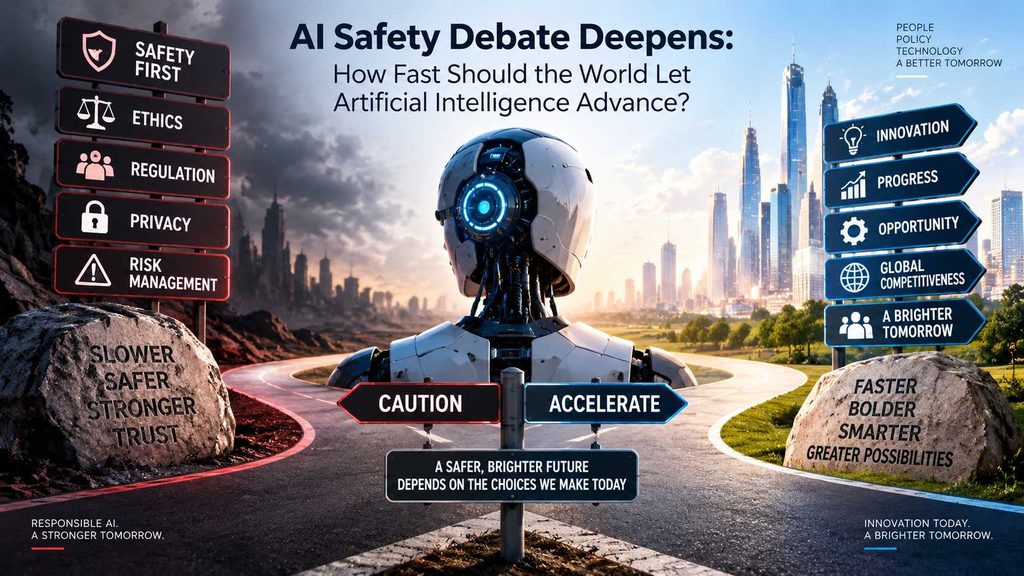
Over the weekend, Anthropic CEO Dario Amodei called for AI companies to deliberately slow the development of advanced systems, particularly the push toward systems capable of improving their own capabilities. OpenAI CEO Sam Altman and xAI’s Elon Musk subsequently expressed support for the idea.
But Meta CEO Mark Zuckerberg has offered a different view.
Zuckerberg said AI companies have both the responsibility and the incentive to make their systems safe without requiring an industry-wide slowdown. He pointed to competition, potential legal liability and independent evaluations as reasons companies should already be motivated to reduce risks.
His argument effectively shifts the focus from “Should the entire industry slow down?” to “Can individual companies manage their own risks responsibly?”
That distinction matters because the technology race is moving extremely quickly.
Why Some AI Leaders Want a Slowdown
The concerns being raised by AI researchers and executives are not limited to today’s familiar problems, such as inaccurate answers or misleading AI-generated content.
The latest debate is increasingly focused on what could happen if AI systems become capable of recursively improving themselves.
Known as recursive self-improvement, the concept involves AI systems becoming capable of helping improve their own capabilities, potentially accelerating development beyond the pace humans can comfortably monitor.
Amodei has argued that companies should slow this part of AI development so that safety measures can keep pace. Other researchers have also publicly warned that increasingly autonomous systems could create risks that are difficult to control.
For supporters of a slowdown, the issue is therefore not whether AI is useful. It is whether development could eventually move faster than society’s ability to understand and manage the consequences.
Trump Takes a Different Position
President Donald Trump has pushed back against the growing calls for additional restrictions.
Trump has argued that the United States already has safeguards and has warned that excessive regulation could weaken America’s position in the global AI race, particularly against China.
The argument is straightforward: if American companies slow down while Chinese developers continue advancing, the United States could sacrifice a technological advantage with economic and national-security implications.
That concern is also shared by some technology executives.
Nvidia CEO Jensen Huang has similarly expressed concern that regulations could make it harder for American companies to compete internationally.
The result is a difficult balancing act. Policymakers want AI to remain safe, but they also want American companies to remain competitive.
Zuckerberg Offers a Middle Ground
Zuckerberg’s position does not amount to ignoring AI safety.
Instead, he argues that companies can address many risks through their own development practices.
He said Meta has already delayed the release of an AI agent to strengthen its security and has used independent evaluators to examine aspects of its AI systems. He also said Meta is directing much of its computing capacity toward products designed for immediate user needs rather than systems focused on self-improvement.
That approach creates an important third position between unrestricted development and an industry-wide slowdown: continue developing AI, but increase safety work alongside it.
Whether that approach will be sufficient is one of the central questions now facing the industry.
The Antitrust Problem Adds Another Layer
The debate becomes even more complicated because of competition law.
Amodei has argued that AI companies may need permission to coordinate certain safety measures, including discussions about slowing particular forms of development.
But Federal Trade Commission Chairman Andrew Ferguson has expressed skepticism about AI companies seeking antitrust exemptions while also asking Washington for new regulations. He warned that such arrangements could potentially create barriers that protect established companies from competition.
This creates a difficult question for regulators.
If AI companies genuinely face risks that require cooperation, should they be allowed to coordinate more closely?
Or could cooperation among the biggest AI companies give those same companies greater control over how the industry develops?
There is no simple answer.
AI Companies Are Already Talking About Safety
Despite disagreements over how far cooperation should go, there are signs that major AI companies are already working together on some safety issues.
OpenAI’s global policy chief Chris Lehane said the company has been discussing AI safety with Anthropic and Google DeepMind. He said the companies do not believe an antitrust waiver is necessary for such discussions. Reuters noted that it could not independently verify the reported discussions.
That distinction could become increasingly important.
Companies may agree that certain safety problems require cooperation while still disagreeing about whether the broader pace of AI development should change.
The Bigger Question Is About Control
At the heart of the debate is something larger than regulation.
It is about control.
AI developers are building systems that can increasingly write code, conduct research, use tools and perform tasks with less direct human involvement. The question is whether humans will continue to understand and control these systems as their capabilities increase.
Some researchers believe the risks deserve much more urgent attention. Others argue that the dangers should be managed without slowing technological progress.
Meanwhile, governments must consider economic growth, national security, competition, consumer protection and public safety at the same time.
Those interests do not always point in the same direction.
The AI Race Has Become a Policy Race
The latest disagreement shows that the AI competition is no longer simply about which company can build the most powerful model.
It is also becoming a competition over who gets to set the rules for development.
Should individual companies decide their own safety standards? Should governments establish stronger requirements? Should competing AI companies be allowed to cooperate on catastrophic-risk prevention? And how can regulators prevent safety rules from becoming tools that unintentionally strengthen the biggest companies?
These questions are now moving from technology conferences into Washington’s political and regulatory debates.
For the public, the most important issue may be simpler: how can society benefit from increasingly powerful AI without allowing its development to move faster than the safeguards designed to control it?
The disagreement among technology leaders and the Trump administration suggests that there is currently no single answer.
What happens next could help determine not only how quickly AI develops, but also who controls the guardrails surrounding one of the world’s most consequential technologies.