For weeks, global attention has focused on military confrontation between the United States and Iran. Now, the spotlight is shifting toward diplomacy—but not simply because another round of peace talks is underway.
At the center of the negotiations lies the Strait of Hormuz, the narrow maritime corridor through which a significant share of the world’s oil and liquefied natural gas exports passes every day.
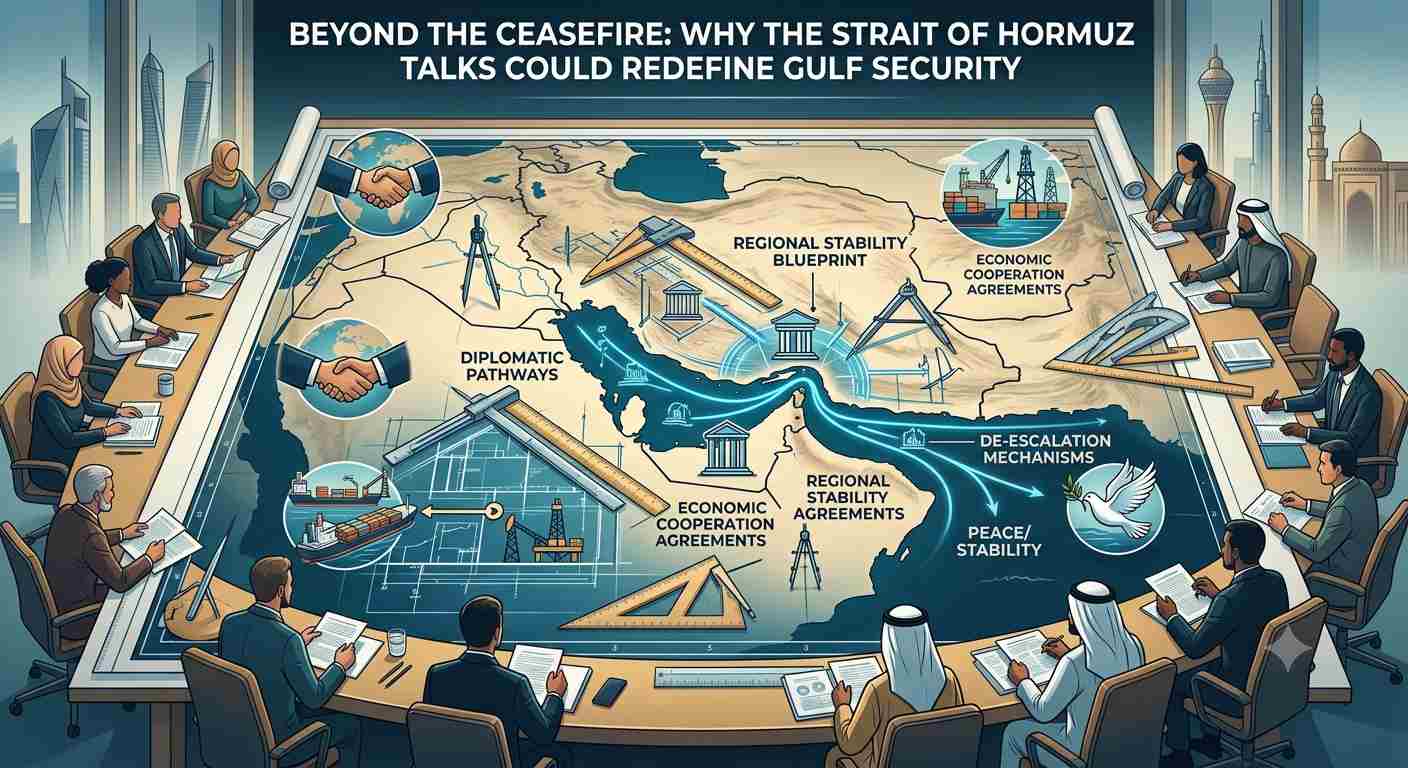
Recent reports suggest that diplomats from the United States, Iran, and Oman are moving closer to an understanding that could restore greater confidence in one of the world’s most strategically important waterways. While reports have pointed to the possibility of an announcement, officials have not yet confirmed that a final agreement has been reached.
Whether negotiations conclude this week or later, the discussions already reveal something significant: the future of Hormuz is becoming a question of regional governance as much as international diplomacy.
The Talks Are About More Than Ending a Crisis
At first glance, reopening shipping lanes appears to be the immediate objective.
However, the negotiations go much further.
They seek to determine who oversees maritime security, how commercial vessels will operate safely, and what responsibilities regional governments will hold in protecting one of the world’s busiest energy corridors.
The outcome could establish principles that influence Gulf security for years rather than simply resolving one temporary dispute.
Oman Has Become the Quiet Diplomatic Bridge
Throughout previous regional crises, Oman has earned a reputation as one of the Middle East’s most trusted mediators.
Maintaining diplomatic relations with multiple regional rivals has allowed Muscat to facilitate conversations that might otherwise never occur.
Its location on the Strait of Hormuz also gives Oman a practical interest in ensuring that commercial navigation remains stable and predictable.
In the current negotiations, Oman is serving not only as a diplomatic intermediary but also as a country directly affected by the future management of the waterway.
The Strait of Hormuz Is an Economic Lifeline
The importance of Hormuz extends far beyond the Gulf.
Energy exported through the strait supplies industries, transportation networks, electricity generation, and manufacturing across Asia, Europe, and other regions.
Even temporary disruptions can influence fuel prices, shipping costs, inflation, and financial markets around the world.
This explains why governments, energy companies, insurers, and shipping operators are closely monitoring every development in the negotiations.
Markets React Before Agreements Become Official
Financial markets often respond to expectations rather than confirmed events.
Reports suggesting diplomatic progress have already influenced oil prices, as traders anticipate reduced risks to energy supplies if maritime traffic becomes more secure.
However, market optimism remains cautious.
Investors recognize that negotiations can change rapidly, and preliminary understandings do not always develop into lasting agreements.
Confidence ultimately depends on implementation rather than headlines.
Maritime Security Requires Shared Rules
Commercial shipping depends on predictability.
Shipowners need clarity regarding navigation procedures, inspections, insurance requirements, emergency communications, and operational responsibilities.
Without clearly defined rules accepted by all major stakeholders, uncertainty itself can become a commercial risk.
One of the negotiations’ most important objectives is therefore establishing practical arrangements that allow shipping companies to operate with greater confidence.
Diplomacy Is Gradually Replacing Military Signaling
Earlier phases of the crisis were dominated by military deployments, missile exchanges, and warnings from multiple governments.
Recent developments suggest that diplomatic engagement is gradually becoming the preferred mechanism for reducing tensions.
Although military deterrence continues to influence regional security, negotiations indicate that all parties recognize the significant economic consequences of prolonged instability.
Diplomacy is increasingly viewed as a means of protecting both regional security and international trade.
Regional Powers Want Greater Responsibility
Another important feature of the discussions is the growing emphasis on regional solutions.
Countries bordering the Gulf increasingly argue that long-term maritime security should involve stronger regional participation rather than relying exclusively on external military powers.
Whether this approach succeeds will depend on building trust among governments with differing strategic interests.
Nevertheless, the negotiations reflect an evolving conversation about regional ownership of security issues.
Stability Benefits More Than Energy Markets
Secure shipping lanes influence far more than oil exports.
Container traffic, food imports, industrial materials, insurance markets, and global manufacturing all depend on reliable maritime transportation.
Reducing uncertainty in Hormuz therefore supports broader economic stability extending well beyond the Middle East.
The benefits of successful negotiations would likely be felt across international supply chains.
The Bigger Picture
The discussions involving the United States, Iran, and Oman demonstrate that the future of the Strait of Hormuz is becoming a defining issue in regional diplomacy.
Although reports have suggested that negotiators are nearing an agreement, the most important question is not when an announcement is made but whether any eventual framework proves durable enough to maintain confidence among governments, energy companies, insurers, and commercial shipping operators.
The negotiations also illustrate how modern diplomacy increasingly combines security, economics, and international commerce. Protecting a strategic waterway today requires not only military preparedness but also shared rules, regional cooperation, and sustained political dialogue.
Ultimately, the success of any Hormuz agreement will not be measured by a single diplomatic announcement. It will be judged by whether ships continue moving safely, energy markets remain stable, and regional tensions gradually give way to more predictable cooperation.
In today’s interconnected global economy, the Strait of Hormuz is more than a narrow channel between two coastlines. It has become a test of whether diplomacy can protect one of the world’s most important trade routes without allowing geopolitical rivalry to dictate the future of international commerce.