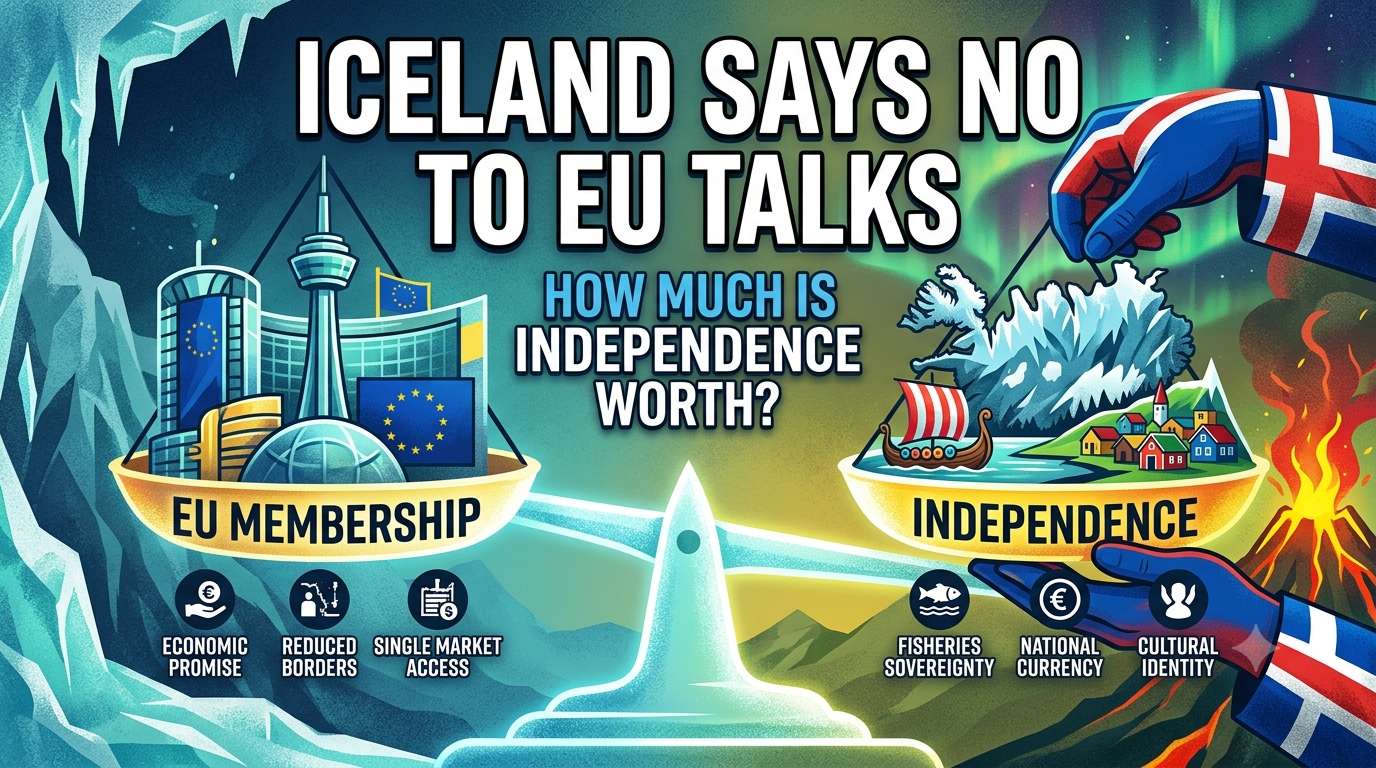
Iceland has delivered a message to Brussels that is more complicated than a simple rejection of Europe.
In a closely fought referendum, Icelanders voted against reopening negotiations to join the European Union, choosing instead to preserve the unusual position their country already occupies: deeply integrated with Europe, but still outside the EU.
The result was close.
Some 52.8% voted “no,” compared with 47.2% who backed restarting negotiations. Turnout reached an impressive 82.5%, demonstrating just how seriously Icelanders regarded a question that has divided the country for more than a decade.
But beneath those numbers lies a much bigger debate.
For Iceland, this was not simply a choice between Europe and independence.
It was a choice over whether the country already has the best of both worlds.
Iceland Didn’t Actually Vote on EU Membership
There is an important distinction in understanding the referendum.
Icelanders were not asked:
“Should Iceland join the European Union?”
They were asked whether the country should resume accession negotiations with Brussels.
Iceland’s membership application, originally submitted in 2009, was never formally withdrawn. Negotiations were suspended in 2013 after a change of government.
A “yes” vote therefore would not have automatically made Iceland an EU member.
Instead, it would have reopened negotiations over the terms under which Iceland might eventually join.
That makes the result particularly revealing.
A narrow majority of Icelanders decided they did not even want to reopen that door—at least for now.
Iceland Already Has Much of What Europe Offers
Why would a small European country reject an opportunity to negotiate EU membership?
Part of the answer is that Iceland already enjoys an unusually close relationship with the bloc.
Through the European Economic Area, Iceland participates extensively in the EU’s single market alongside Norway and Liechtenstein.
Iceland is also part of the Schengen passport-free travel area.
Its citizens and businesses therefore receive many practical benefits associated with European integration without Iceland becoming a full EU member.
Prime Minister Kristrún Frostadóttir acknowledged this after the referendum.
One of the clearest lessons from the result, she said, was that Icelanders appear broadly satisfied with the EEA arrangement.
That may be the central story of the vote.
For many voters, the question wasn’t “Why shouldn’t we join Europe?”
It was “What would full membership give us that we don’t already have?”
Fishing Beat Geopolitics
The government tried to frame EU membership discussions partly through the changing security environment.
Trade wars are intensifying.
Competition in the Arctic is growing.
Questions have emerged over America’s long-term commitment to European security.
US President Donald Trump’s repeated interest in acquiring Greenland has added another layer of uncertainty to politics in the Arctic.
Supporters of restarting EU negotiations argued that closer integration with Europe could provide Iceland with additional economic and geopolitical security.
But many voters were focused on something considerably closer to home.
Fish.
Iceland’s Waters Are More Than an Industry
For most countries, fishing policy might appear to be a specialist economic issue.
For Iceland, it touches national identity.
Fishing contributes around 15% of the country’s GDP when direct and indirect activity is included and accounts for approximately 40% of export revenue.
For centuries, Iceland’s prosperity has been tied to the waters surrounding the island.
That makes control over fishing quotas extraordinarily sensitive.
Opponents of EU accession fear that joining the bloc could eventually reduce Iceland’s ability to determine how its fisheries are managed.
EU supporters dispute the severity of that risk and argue that Iceland could negotiate favorable arrangements, particularly because other EU countries have little historical fishing activity in Icelandic waters.
But opponents were unconvinced.
For them, the question was not simply whether Brussels might offer a good deal today.
It was whether Iceland could guarantee control of its waters decades from now.
Reykjavik and Rural Iceland Saw Different Futures
The geographical breakdown of the vote reveals another important divide.
Only the two constituencies in central Reykjavik produced majorities supporting renewed negotiations.
Rural Iceland and Reykjavik’s suburbs voted against.
That pattern matters.
Urban voters may be more likely to view European integration through opportunities involving trade, travel, education and economic stability.
In fishing and agricultural communities, sovereignty over natural resources can feel much more immediate.
The referendum therefore exposed two different visions of Iceland’s future.
One sees deeper European integration as protection in an uncertain world.
The other sees national control as the protection.
The Economy Gave the ‘Yes’ Side a Powerful Argument
EU supporters nevertheless had a strong economic case to make.
Iceland has struggled with inflation and high borrowing costs.
Its central bank interest rate stands at around 8%.
By comparison, the European Central Bank’s rate is considerably lower at 2.25%.
For households carrying mortgages, that difference is impossible to ignore.
Supporters argued that eventual EU membership—and potentially adopting the euro—could contribute to greater financial stability and lower borrowing costs.
Iceland’s small currency can leave its economy more exposed to external shocks.
A larger monetary system could potentially provide greater stability.
But voters apparently weren’t convinced that Brussels was the necessary solution.
Icelanders Don’t Feel They Are in a Crisis
This may be one of the most important explanations for the result.
Iceland originally applied for EU membership in 2009 after the global financial crisis devastated its banking system.
Back then, vulnerability was obvious.
The country had just experienced an extraordinary economic shock, making the security of a larger economic bloc more attractive.
The situation today is different.
Iceland certainly faces economic problems.
Interest rates are high.
Inflation has hurt consumers.
Housing costs remain challenging.
But relatively high salaries have softened some of that pain.
There simply wasn’t the same sense of emergency that existed after the financial crisis.
And without a crisis, surrendering even part of Iceland’s decision-making independence becomes harder to sell.
The Vote Is Also a Setback for Brussels
For the European Union, the result carries significance beyond Iceland’s population of roughly 400,000.
EU officials had hoped Iceland could become a relatively straightforward candidate for membership.
The country is already closely aligned with European regulations, participates in the single market and is a stable democracy.
Iceland’s membership could also have strengthened the EU’s strategic position in the Arctic.
As competition involving Russia, the United States, Europe and China increasingly reaches northward, Iceland’s geography has become more important.
A successful Icelandic accession process might also have provided positive momentum for EU enlargement at a time when membership debates elsewhere remain politically difficult.
Instead, Brussels received another reminder that even countries closely integrated with Europe do not automatically want full membership.
This Isn’t Iceland Turning Away From Europe
That distinction is crucial.
The referendum should not be interpreted as Iceland suddenly becoming anti-European.
Iceland isn’t leaving the EEA.
It isn’t leaving Schengen.
It isn’t abandoning NATO.
Nor is it severing economic relationships with the European Union.
Frostadóttir has instead indicated that her government will focus on strengthening Iceland’s existing relationship with Europe through the EEA framework.
In other words, Icelanders did not vote to build a wall between themselves and Europe.
They voted to keep the relationship roughly where it already is.
Iceland May Be Choosing a ‘Middle Way’
That makes Iceland an interesting example in a world increasingly divided into political and economic blocs.
Countries are often described as facing binary choices.
Join one camp or another.
Integrate or remain independent.
Align with Washington, Brussels, Beijing or Moscow.
Iceland’s position demonstrates that international relationships do not always work that way.
The country can participate in Europe’s single market.
It can maintain passport-free travel.
It can cooperate with European institutions.
It can remain inside NATO.
And it can simultaneously retain control over important areas of national policy by staying outside the EU.
Think of Iceland’s relationship with Europe as having a seat close to the table without signing up for every item on the menu.
For many Icelanders, that arrangement appears good enough.
A Small Country Is Making a Bigger Statement About Sovereignty
The referendum ultimately tells us something larger about modern European politics.
Economic integration does not automatically erase the desire for national control.
Security fears do not automatically make voters willing to transfer more authority to multinational institutions.
And economic difficulties do not necessarily persuade people that a larger political union offers the solution.
Icelanders were presented with powerful arguments for reopening the European question.
High interest rates made economic integration attractive.
Growing Arctic competition strengthened the security argument.
Global trade tensions made a larger economic bloc look safer.
Yet fishing rights, sovereignty and satisfaction with the existing EEA relationship ultimately carried more weight.
That is why describing the result simply as Iceland saying “no” to Europe misses the point.
Iceland hasn’t rejected Europe. It has rejected the argument that becoming more deeply integrated with Europe is currently worth giving up some of the independence it already possesses.
For Brussels, that is a setback.
For Iceland, it may represent something different: a vote of confidence in the middle ground.