In the digital age, news of an explosion can travel across the world in seconds—often long before investigators determine what actually happened.
That was the situation after videos circulated online claiming that multiple explosions occurred near Dubai’s Jebel Ali industrial and port district, with witnesses describing several loud blasts over a short period and images showing smoke rising into the night sky. While the footage quickly spread across social media, authorities had not immediately confirmed the exact cause of the incident, and independent verification remained limited during the early hours of reporting.
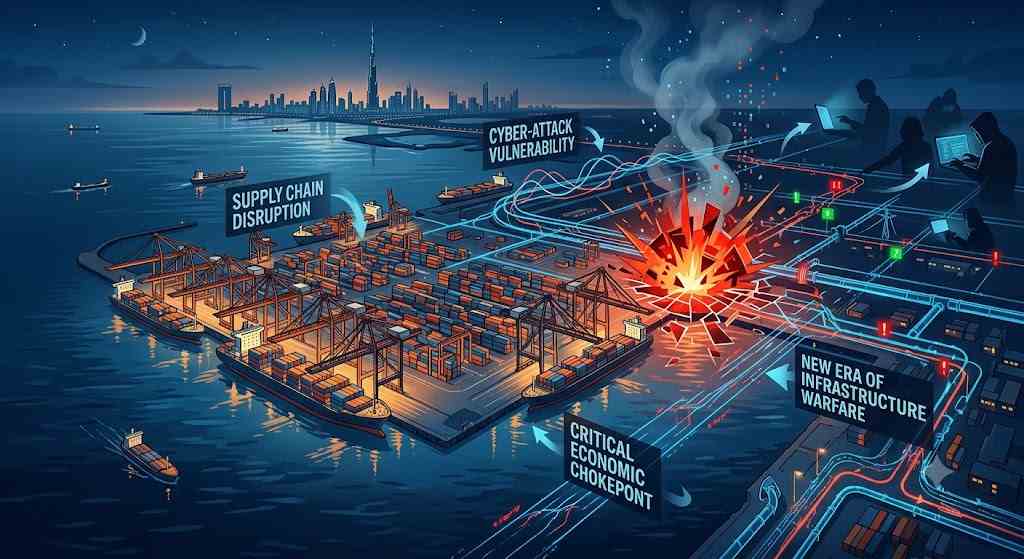
Whether the incident ultimately proves to be the result of military action, an industrial accident, or another cause, it highlights a much broader reality: in modern geopolitical crises, strategic infrastructure has become as significant as traditional military targets.
Ports Have Become Strategic Assets
Jebel Ali is not simply one of Dubai’s largest ports.
It is among the world’s busiest logistics hubs, connecting shipping routes across Asia, Europe, Africa, and the Middle East.
Every day, thousands of containers carrying consumer goods, industrial equipment, food supplies, and energy-related cargo move through its terminals.
Any disruption—whether real or perceived—can affect shipping schedules, insurance costs, and commercial confidence well beyond the United Arab Emirates.
Modern economies depend on uninterrupted logistics.
Information Moves Faster Than Confirmation
One defining feature of contemporary conflicts is the speed at which information spreads.
Videos recorded by residents, satellite imagery, social media posts, and unofficial online accounts often appear before emergency services complete their initial assessments.
While this provides immediate visibility, it also increases the risk of misinformation.
Unverified claims can influence financial markets, public behavior, and international perceptions before official investigations establish the facts.
For that reason, distinguishing verified information from online speculation has become an essential part of responsible reporting.
Strategic Infrastructure Faces Growing Risks
Modern conflicts increasingly extend beyond conventional military installations.
Ports, airports, energy facilities, communication networks, warehouses, and transportation corridors now play a central role in national security because they support both economic activity and emergency response.
Protecting these facilities has therefore become a strategic priority for governments across the region.
The resilience of critical infrastructure is now considered a component of national defense.
Markets React to Uncertainty
Financial markets often respond to uncertainty faster than to confirmed damage.
Even reports of possible disruptions at major ports can influence shipping companies, insurers, and commodity traders.
Energy prices, freight rates, and war-risk insurance premiums may all change based on perceived rather than confirmed threats.
This demonstrates how confidence itself has become an important economic asset during periods of geopolitical tension.
Cities Must Prepare for Multiple Scenarios
Large international cities such as Dubai are designed to withstand a wide range of emergencies.
Fire services, civil defense authorities, medical teams, port operators, and emergency management agencies regularly prepare for industrial accidents, hazardous material incidents, natural disasters, and potential security threats.
Preparedness depends not only on preventing incidents but also on maintaining public confidence while investigations are underway.
Rapid response helps limit both physical damage and economic disruption.
The Digital Battlefield Is Expanding
Conflicts today unfold simultaneously in physical and digital spaces.
Images, videos, and claims circulating online can shape public opinion long before governments release official statements.
This creates pressure on journalists, emergency responders, and policymakers to provide timely and accurate information while avoiding premature conclusions.
Verification has become one of the most valuable tools during crises.
Regional Stability Depends on Commercial Confidence
Dubai’s importance extends beyond the United Arab Emirates.
Its ports, airports, financial institutions, and logistics centers support regional trade across the Gulf and connect international supply chains linking Europe, Asia, and Africa.
Maintaining confidence in these systems is therefore important not only for local businesses but also for global commerce.
Even temporary uncertainty surrounding critical infrastructure can influence investment and trade decisions.
Resilience Is Measured by Recovery
The true strength of a city is not determined solely by whether incidents occur.
It is measured by how effectively authorities respond, communicate, restore operations, and reassure residents and businesses afterward.
Cities that recover quickly preserve both economic activity and public trust.
This resilience has become increasingly important in an era where regional crises can generate immediate global attention.
The Bigger Picture
The reported explosions near Dubai’s Jebel Ali area illustrate how strategic infrastructure has become a focal point during periods of heightened geopolitical tension.
Although investigators must determine exactly what occurred, the incident already demonstrates the importance of accurate information, effective emergency response, and resilient logistics systems.
It also highlights a defining characteristic of modern crises: perception can sometimes spread faster than confirmed facts. Social media images may influence markets and public opinion within minutes, while official investigations require time to establish the truth.
Ultimately, the significance of the event extends beyond the explosions themselves. It underscores how ports, transport hubs, and industrial facilities have become essential elements of national resilience in an interconnected global economy.
Whether the incident proves to be security-related or not, one lesson remains clear: protecting critical infrastructure today means safeguarding not only physical assets but also public confidence, commercial continuity, and the credibility of verified information in an increasingly fast-moving world.